

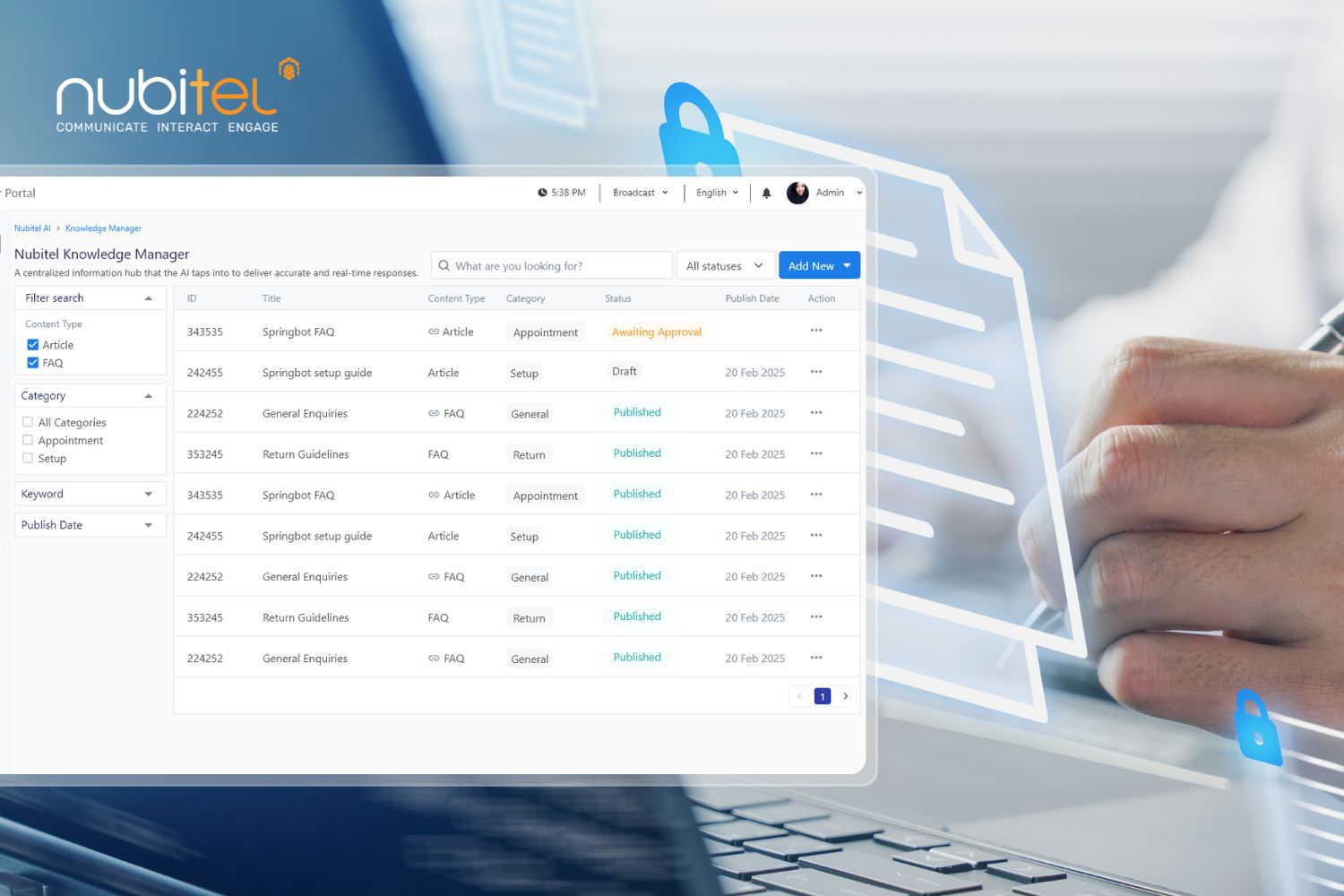
In customer service, delivering a good experience depends heavily on how quickly and accurately teams can access the right information.
But in most contact centers, that process is far from smooth. Agents switch between systems, search through outdated documents, or rely on senior colleagues mid-conversation.
Customers feel the impact immediately in inconsistent answers, long wait times, and self-service that fails to resolve their issues.
AI knowledge management for customer service addresses this challenge by making knowledge easier to find, easier to maintain, and easier to use directly within customer interactions.
This guide covers what it is, why it matters, what to look for in a system, and how to implement it effectively.
Table of Contents
ToggleWhat is AI knowledge management
Knowledge management (KM) is how organizations capture, organize, and deliver the information their teams need to serve customers.
AI in knowledge management brings intelligence into that process. Using technologies like natural language processing (NLP), large language models (LLMs), retrieval-augmented generation (RAG), and generative AI (GenAI), an AI knowledge management system doesn’t just store information; it understands what’s being asked, evaluates context, and surfaces the right answer for that specific interaction.
Why AI knowledge management is critical for customer service
Knowledge management is consistently underinvested in customer service, despite being one of its biggest performance levers. Gartner named it #1 technology for improving operational performance, customer experience, and employee experience in contact centers. Their analysts described the gap directly:
Timely and contextual knowledge presented to agents in a clear and concise form is a pipe dream for most service environments, yet without it the service experience will always be in jeopardy… Knowledge is an underemphasized aspect of experience design and demands a higher prioritization.
Gartner, September 2021
Industry data reinforces this. A Forrester Consulting consumer survey found that the top three barriers to good customer service are all knowledge failures: different agents giving different answers (41%), agents not knowing the answer (34%), and customers unable to find answers on the website (31%).
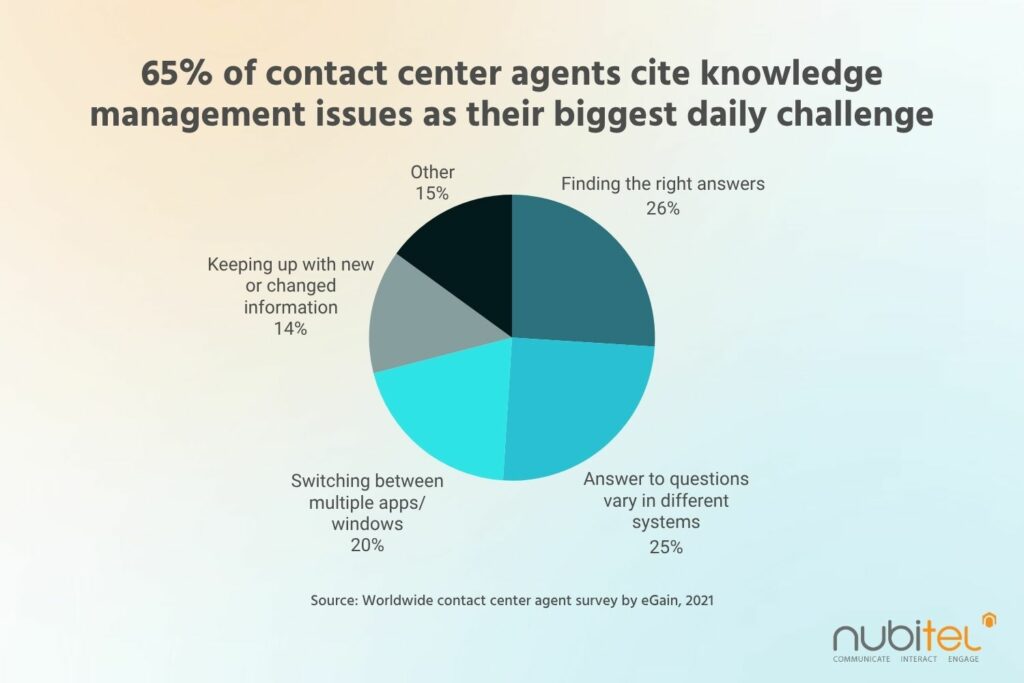
On the agent side, the picture is just as clear. An eGain survey found that 65% of contact center agents cite knowledge management issues as their biggest daily challenge.
When knowledge is centralized, governed, and delivered in context, agents stop searching and start resolving. That’s where AI-powered knowledge management for customer service delivers measurable improvements in first contact resolution (FCR), average handle time (AHT), customer satisfaction (CSAT), and agent productivity.
Five capabilities that define a high-performing AI knowledge management system
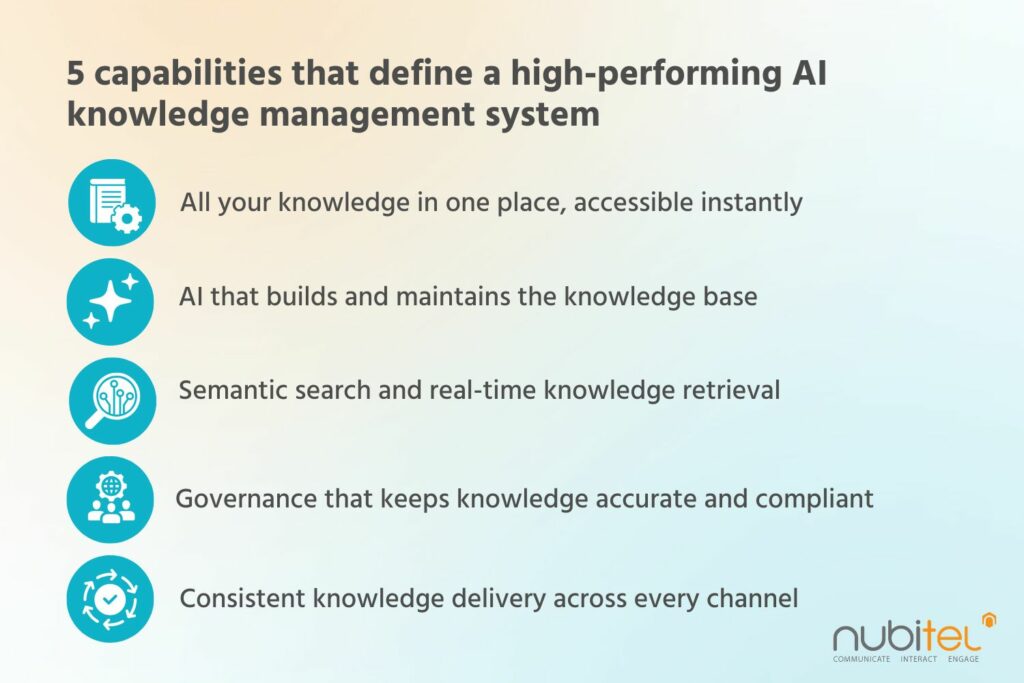
Not all AI knowledge management tools are built for real contact center environments. The difference lies in how well they support day-to-day operations, from content creation to real-time usage.
1. All your knowledge in one place, accessible instantly
In many organizations, knowledge is spread across SharePoint folders, email threads, CRM fields, and individual agent notes. This fragmentation slows down access and leads directly to inconsistent answers.
A modern customer service knowledge base brings all of this information into one governed environment, making it accessible to both agents and AI-powered tools.
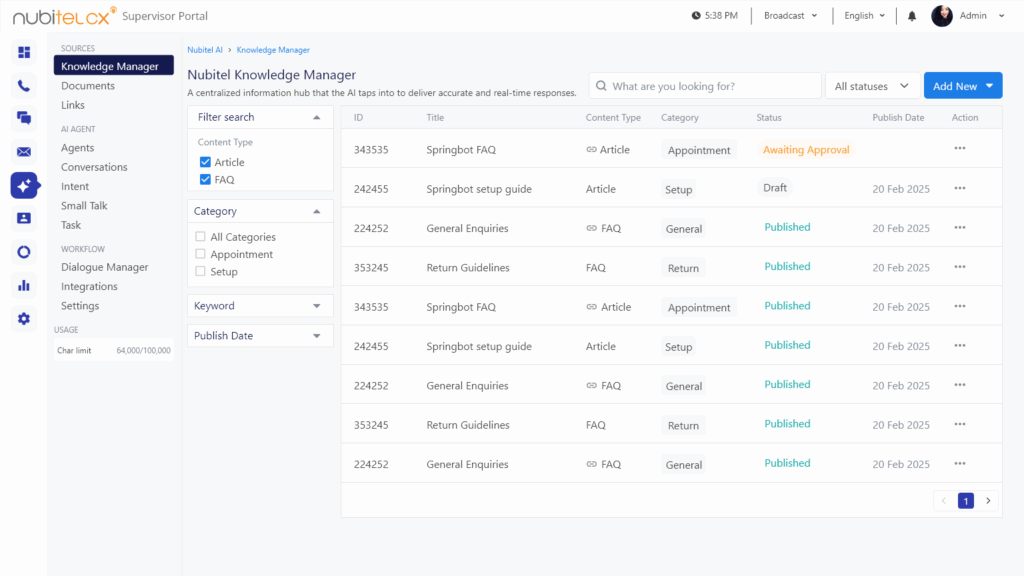
Nubitel Knowledge Management System consolidates all your enterprise knowledge, including articles, documents, and links, into a single system used across the contact center. Agents no longer need to switch between tabs or guess where information is stored. The result is faster access, fewer errors, and a more efficient workflow.
2. AI that builds and maintains the knowledge base
Creating knowledge is not the main challenge. Keeping it structured, accurate, and usable over time is.
The best AI knowledge management tools reduce manual effort while improving how knowledge is created and maintained.
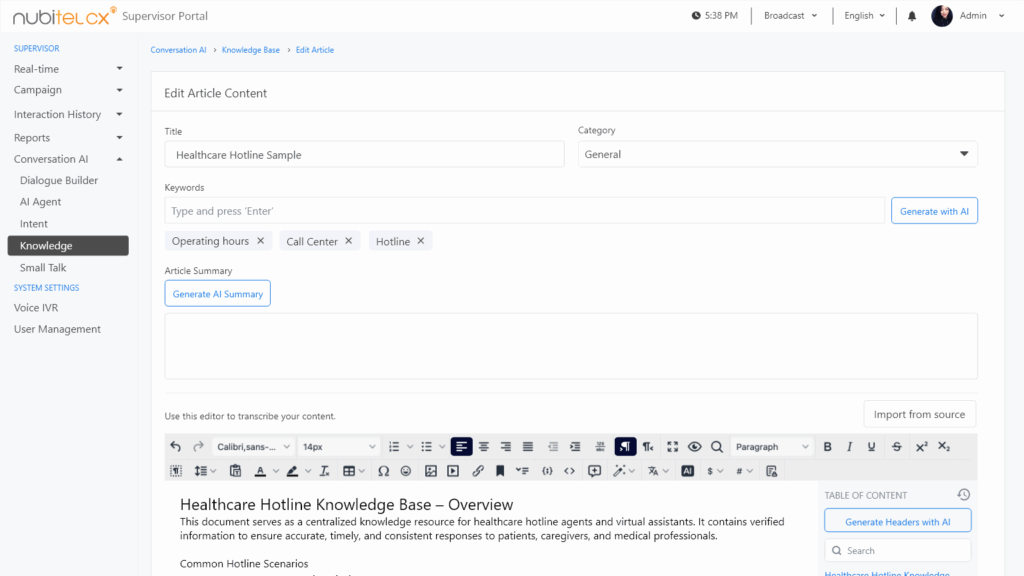
Nubitel Knowledge Management System applies AI-powered knowledge management to transform how enterprise knowledge is handled. Its AI Editor converts unstructured content into structured formats that are easier for both agents and AI systems to use. This process is supported by smart chunking, which breaks long and complex documents into smaller, meaningful sections. These structured sections make knowledge easier to read for humans and more precise for AI retrieval.
Additional capabilities further improve content quality and usability. Keyword extraction enhances search accuracy by automatically identifying relevant terms. FAQ generation turns existing documents into ready-to-use answers. Article summaries provide quick context, helping agents understand key points faster during interactions.
Together, these features ensure that knowledge is not only created more efficiently but also remains usable and relevant at scale.
3. Semantic search and real-time knowledge retrieval
Agents do not search using perfect keywords, especially during live interactions. They ask questions naturally and expect immediate, relevant answers.
This is why AI in knowledge management must go beyond basic search and support context-aware retrieval in real time. An effective AI knowledge management system should be able to interpret intent, understand variations in phrasing, and deliver accurate answers within the flow of work.
In practice, this requires more than a standalone knowledge base. It depends on how well knowledge connects with the tools that support live interactions.
At Nubitel, while Nubitel Knowledge Management System serves as the governed knowledge foundation, semantic understanding and real-time retrieval are delivered through its integration with Nubitel AI Agent Assist and Nubitel AI Agent.
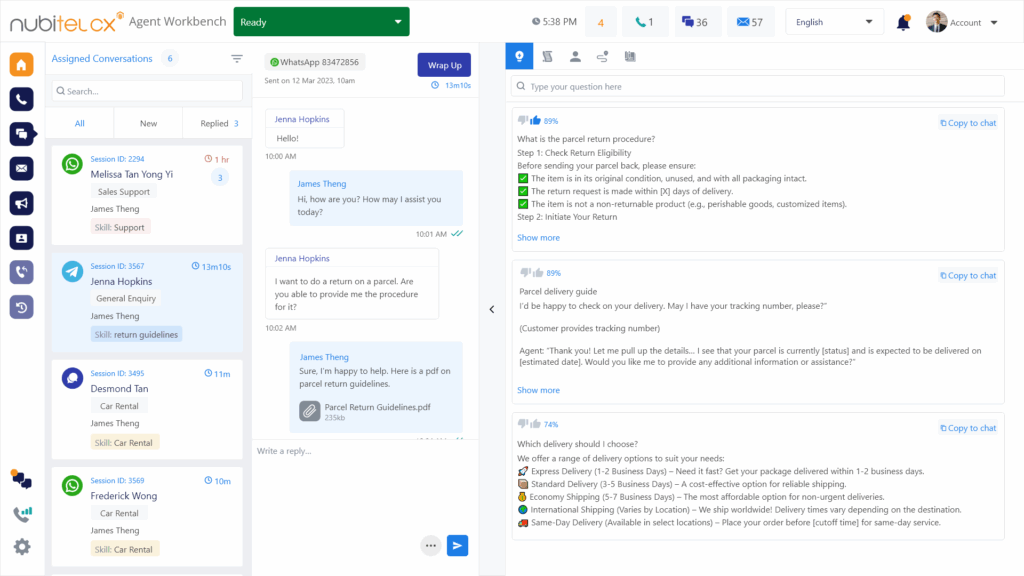
AI Agent Assist analyzes live interactions and uses LLMs to interpret agent queries, while RAG ensures that responses are grounded strictly in approved knowledge from Nubitel Knowledge Management System. At the same time, AI Agents use the same knowledge base to power automated customer interactions.
This connected approach ensures that knowledge is not just stored correctly, but also delivered accurately and in context during real customer conversations. It is a practical example of how AI improves knowledge management workflows by embedding knowledge directly into the flow of work.
4. Governance that keeps knowledge accurate and compliant
Speed in customer service should never come at the expense of accuracy.
That is why governance must be built into the knowledge management process, not treated as an afterthought.
Nubitel Knowledge Management System embeds guardrails throughout the entire knowledge lifecycle. Content moves through structured stages including draft creation, review, revision, approval, and publishing. Each step is controlled and traceable.
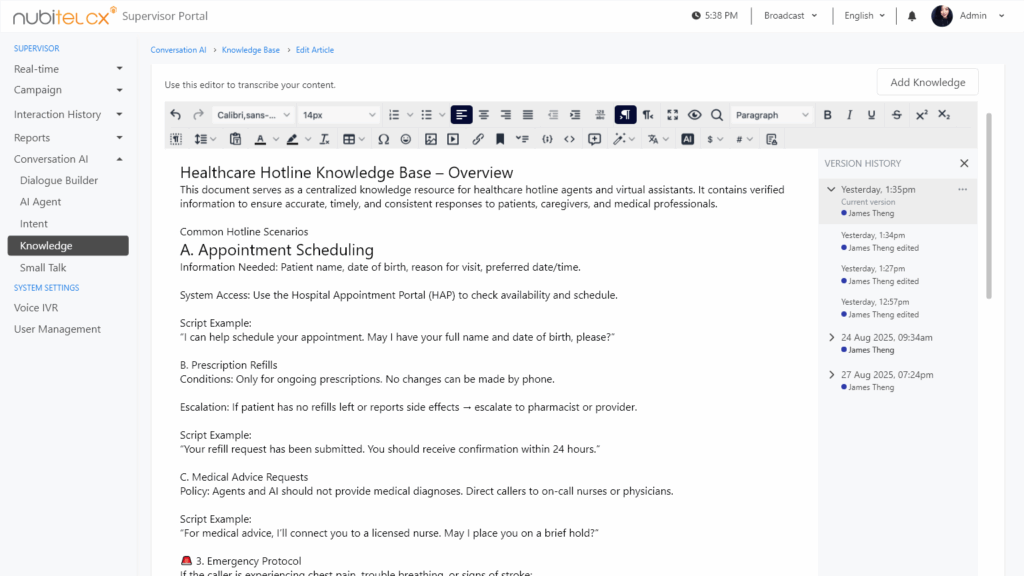
Version control and audit trails ensure that only the most up-to-date and approved information is accessible to agents and AI systems. This reduces the risk of outdated or incorrect responses and supports regulatory requirements.
With this approach, organizations can scale their customer service knowledge base confidently while maintaining accuracy, consistency, and compliance.
5. Consistent knowledge delivery across every channel
Customers expect the same accurate answer regardless of how they reach out, whether through voice, chat, email, messaging, or self-service.
When different channels rely on different knowledge sources, inconsistencies naturally appear. Over time, this leads to confusion, repeated contacts, and reduced confidence in the service experience.
Nubitel Knowledge Management System makes sure that all customer-facing tools reference the same governed knowledge base. Through integration with AI Agent Assist and AI Agents, both human-assisted and automated interactions draw from the same approved content.
This means agents receive real-time guidance based on the same knowledge that powers self-service automation. The result is consistent, accurate responses across every channel, fewer escalations, and a more dependable customer experience.
>>> Read more: How AI elevates contact center agent experience
How to implement AI knowledge management: From planning to continuous improvement
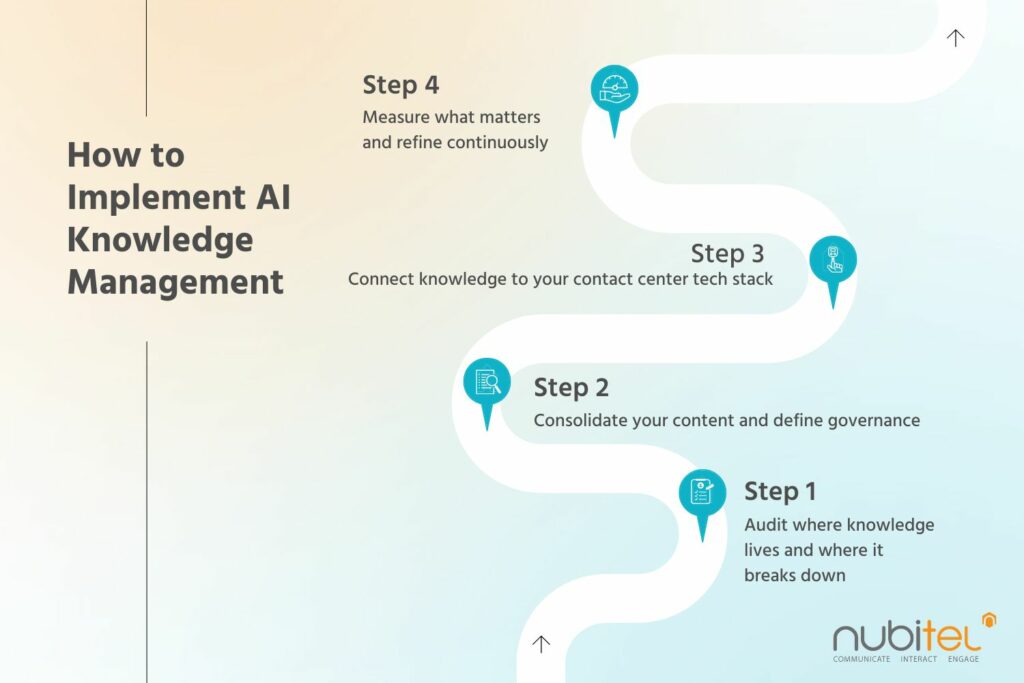
Successfully implementing AI knowledge management for customer service requires more than deploying a tool. It involves aligning content, processes, and systems so knowledge can flow seamlessly into customer interactions.
Step 1: Audit where knowledge lives and where it breaks down
Start by mapping your current knowledge landscape. Identify where information is stored, how agents access it, and where breakdowns occur. Look at which interactions take the longest to resolve, where customers drop off in self-service, and where agents need to escalate or seek help.
This creates a clear baseline and helps prioritize what needs to be improved first.
Step 2: Consolidate your content and define governance
Next, bring together all relevant knowledge sources, including FAQs, product documentation, CRM notes, ticket histories, and policies.
At the same time, define ownership and governance clearly for your customer service knowledge base. Determine who is responsible for each content area, how reviews and approvals will be handled, and how updates will be managed. This ensures knowledge remains accurate and consistent over time.
Step 3: Connect knowledge to your contact center tech stack
To deliver real impact, the AI knowledge management system must be integrated into the tools agents use every day.
This includes CRM systems, ticketing platforms, conversational AI, and agent assist tools. When connected, knowledge is delivered directly within workflows, in context, at the moment it is needed.
This is how AI search in knowledge management becomes operational rather than theoretical.
Step 4: Measure what matters and refine continuously
Finally, track key performance indicators such as FCR, AHT, CSAT, and self-service success rates before and after implementation.
Use these insights to identify what is working and where gaps remain. Establish a regular review process to update content, improve coverage, and refine workflows.
This is how contact centers effectively measure and demonstrate the ROI of AI in knowledge management.
>>> Looking for a faster, easier way to kick off customer service knowledge management? Check out the video below!
Build a stronger customer service foundation with Nubitel Knowledge Management System
Most contact centers already have the knowledge they need, but without effective knowledge management for customer service, it remains scattered, inconsistently maintained, and difficult to access, limiting its value for both agents and customers.
Nubitel Knowledge Management System brings all organizational knowledge into one governed, AI-powered knowledge management system that is designed to work across the entire customer service ecosystem.
By combining AI-assisted content structuring, semantic retrieval, and built-in governance, it allows teams to deliver faster, more accurate, and more consistent responses.
It is also designed for multilingual environments, supporting English, Chinese, Thai, Vietnamese, Bahasa Malaysia, and Indonesian, enabling organizations to scale knowledge consistently across regions.
Whether the goal is to improve resolution rates, reduce handling time, or deliver more effective self-service, Nubitel Knowledge Management System provides a practical and scalable foundation.
Schedule a demo now to see how Nubitel Knowledge Management System performs in your contact center environment.
FAQs
What is AI knowledge management?
AI knowledge management is the use of technologies such as NLP, LLMs, RAG, and GenAI to capture, organize, retrieve, and maintain knowledge. In customer service, it ensures agents and AI systems can access accurate, context-relevant answers during interactions.
How does AI enhance traditional knowledge management systems?
Traditional knowledge management relies on manual processes and keyword-based search. This often leads to outdated content and slow retrieval. AI knowledge management introduces automation, semantic understanding, and continuous optimization. It improves how knowledge is structured, maintained, and delivered, making it faster and more reliable in real-world use.
How can AI support knowledge management in a contact center?
AI supports knowledge management for customer service by structuring unstructured content, improving search accuracy, generating FAQs, and delivering answers directly within agent and self-service workflows. It also ensures that responses are grounded in approved knowledge through technologies like RAG.
How to measure ROI of AI in knowledge management?
ROI can be measured by tracking improvements in key metrics such as First Contact Resolution (FCR), Average Handle Time (AHT), Customer Satisfaction (CSAT), and self-service success rates. Additional indicators include reduced training time for new agents and increased productivity across teams.
What are the most common challenges in maintaining a knowledge base?
Content going outdated, knowledge scattered across multiple systems, inconsistent tagging, and the manual effort of keeping pace with product or policy changes. An AI-powered knowledge management system addresses all of these by monitoring content performance, flagging gaps and stale articles automatically, and assisting authors with summarization and FAQ generation so maintenance becomes manageable at scale.