


The conversation around AI in customer service is often framed as a choice between automation and human agents. In reality, delivering great customer experiences requires both.
While AI can automate routine tasks, retrieve information, and execute workflows at scale, many customer interactions still require human judgment, empathy, and accountability.
This shift is driving greater focus on human-AI collaboration in customer service, where AI and employees work together as a coordinated system.
By combining AI substitution for structured tasks with AI augmentation for complex interactions, organizations can improve efficiency, empower agents, and deliver more consistent customer outcomes.
Table of Contents
ToggleUnderstanding the AI technologies reshaping customer service
Designing effective human-AI collaboration in customer service requires understanding how AI operates across the customer service stack.
Agentic AI is the broader approach to building AI-powered workflows, often involving one or more AI agents, while AI agent assist solutions focuses on supporting human agents in real time. Although closely related, these capabilities serve different operational purposes.
Agentic AI: A broader approach to AI-powered service delivery
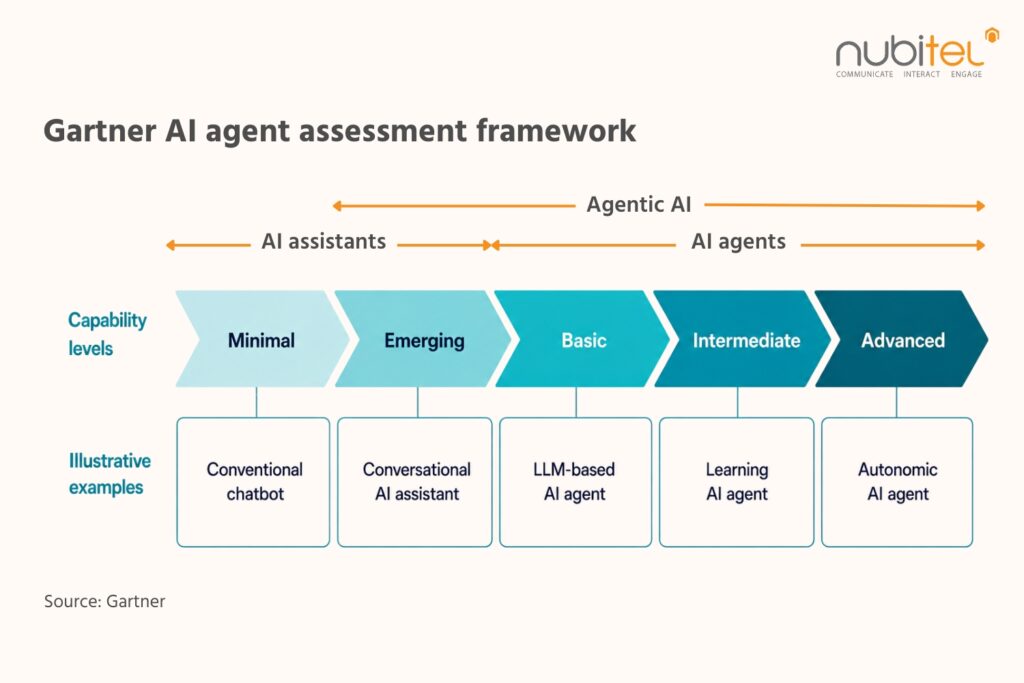
Agentic AI refers to a broader approach to building AI-powered solutions that involves the use of one or more AI agents within a workflow. Rather than describing a specific tool, it describes how AI is applied to achieve an outcome across a process.
Gartner predicts that by 2029, agentic AI will autonomously resolve 80% of common customer service issues, enabling organizations to cut operational costs by 30%.
In contact centers, agentic AI may coordinate multiple activities such as retrieving customer information, accessing enterprise knowledge, executing actions in business systems, and escalating exceptions to human agents when required.
The shift is from automating individual tasks to orchestrating workflows that combine AI-driven actions, enterprise systems, and human oversight.
While this creates opportunities to automate more operational work, agentic AI also introduces new governance challenges. As workflows become more autonomous, organizations must address issues such as accountability, monitoring, security, and risk management across multiple interacting AI components.
>>> Read more: Guardrails for AI Agents: How to Keep Your Customer Service Safe, Compliant, and Reliable
AI agents: Software entities that take action
AI agents are software entities that use artificial intelligence to evaluate information, determine an appropriate action, and execute that action to achieve a specific outcome.
Unlike AI systems that primarily generate content or recommendations, AI agents are designed to take action within digital systems. They may operate autonomously or semi-autonomously, often involving a human at some stage of the workflow.
In customer service environments, AI agents may update records, process requests, retrieve information, trigger workflows, or initiate customer communications.
Their value lies in execution. However, AI agents are typically most effective when operating within clearly defined objectives and constrained environments. Rather than replacing entire roles, they are designed to automate specific tasks or portions of a workflow.
AI agent assist: Real-time workforce augmentation
AI agent assist solutions are built to augment frontline agents during customer interactions by surfacing relevant information, retrieving enterprise knowledge, and reducing manual effort.
Gartner predicts that by 2028, 80% of customer service organizations will implement agent-assist solutions to support their workforce.
Modern agent-assist solutions are characterized by conversational experiences powered by generative AI, RAG-based semantic search across enterprise content, and integrations with knowledge management and operational systems.
Unlike traditional search tools that require agents to actively look for information, agent-assist solutions embed knowledge directly within the workflow. They proactively surface relevant content based on the live interaction, retrieve information across multiple systems, and synthesize it into actionable guidance.
Typical capabilities include contextual knowledge retrieval, real-time recommendations, next-best-action guidance, automated summaries, and GenAI-powered answer generation.
The goal is not to automate the interaction itself, but to help agents make better decisions, respond more consistently, and resolve issues more efficiently.
AI substitution vs AI augmentation: Defining the right operating model
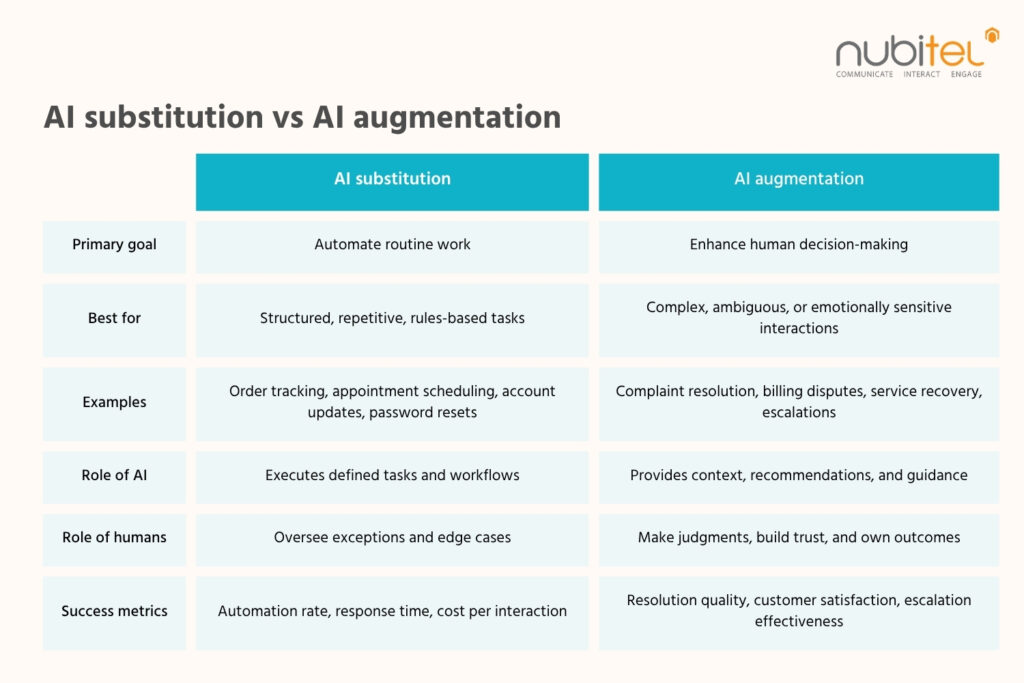
One of the biggest misconceptions in AI contact center is treating AI agents and human agents as interchangeable resources.
Terms such as “digital employee” or “AI co-worker” can create the impression that AI agents are simply human agents in software form. In reality, AI agents are software entities built to execute specific actions within defined environments. They lack the flexibility, judgment, and long-term reasoning that human employees apply across diverse situations, making AI augmentation – not AI substitution – the more effective and sustainable operating model.
AI substitution: Automating predictable work
AI substitution is suitable for work that is predictable, rules-based, and clearly bounded.
Examples include account updates, appointment scheduling, order tracking, password resets, and other routine service requests where the objective is well defined and the number of possible outcomes is limited.
In these scenarios, AI agents can improve speed, availability, and operational efficiency by executing tasks consistently at scale. The value comes from automating repeatable work, not replacing an entire customer service function.
This distinction matters because AI agents perform best when operating within constrained environments and clearly defined objectives. As workflows become more variable, the limitations of autonomous decision-making become more apparent.
AI augmentation: Elevating human expertise
Customer service extends far beyond transactional requests.
Many interactions require interpretation, negotiation, empathy, and accountability. Complaint resolution, billing disputes, service recovery, retention conversations, and high-value customer engagements often involve ambiguity that cannot be resolved through predefined workflows alone.
In these situations, AI creates value through augmentation rather than substitution.
AI agent assist solutions can surface customer history, retrieve relevant policies, recommend next actions, and synthesize information from multiple sources in real time. This reduces cognitive load and helps agents make more informed decisions, while leaving responsibility for judgment and resolution with the human employee.
The goal is not to automate human decision-making, but to improve it.
Why human-AI collaboration in customer service becomes essential
As customer service environments become more complex, organizations increasingly need both automation and human expertise operating together.
AI agents can execute structured tasks with speed and consistency, but they cannot fully replicate human understanding of emotional context, nuanced situations, or customer expectations. In many service scenarios, from complaint handling to accessibility accommodations and premium customer experiences, the human interaction itself is part of the value being delivered.
This is why the future of customer service is unlikely to be fully autonomous. Instead, organizations are moving toward operating models where AI systems handle defined tasks while human employees focus on judgment, relationship management, and exception handling.
The most significant workforce shift is not AI replacing human agents. It is the growing advantage of employees who can effectively work alongside AI systems. As AI becomes embedded across customer service operations, the ability to leverage AI-driven insights, recommendations, and automation will become a core capability of high-performing service teams.
This also reshapes organizational roles. Agents become customer experience orchestrators rather than transaction processors. Supervisors spend more time coaching and performance enablement. Knowledge teams increasingly focus on governance, content quality, and AI readiness.
In this model, AI does not replace the workforce. It changes how the workforce operates.
>>> You might be interested: How AI Elevates Contact Center Agent Experience
Operationalizing human-AI collaboration in customer service
Human-AI collaboration in customer service requires more than deploying AI tools. It requires a connected foundation where knowledge, automation, and human workflows work together.
At the center is trusted knowledge. Nubitel Knowledge Management System provides a centralized source of data that ensures both AI systems and employees operate with accurate, governed, and up-to-date information.
Built on this foundation, Nubitel AI Agent Assist augments human agents during live interactions. By combining enterprise knowledge, customer context, and AI-powered recommendations, it helps agents access relevant information, navigate conversations, and make better decisions in real time. It also supports continuous performance improvement through real-time guidance, compliance support, automated interaction evaluation, and coaching insights that help managers identify development opportunities and improve agent effectiveness.
For AI substitution, Nubitel AI Agent automates routine enquiries and workflow-driven interactions across voice and digital channels, enabling organizations to scale service operations while reserving human expertise for more complex situations.
Meanwhile, Nubitel Conversation Analytics provides visibility across both AI and human interactions, helping organizations monitor service quality, identify improvement opportunities, uncover customer sentiment trends, and optimize customer experience performance.
Together, these capabilities create a connected ecosystem where AI and human agents complement each other’s strengths, enabling customer service teams to operate more efficiently, consistently, and at scale.
Ready to put human-AI collaboration into practice?
The organizations that outperform their peers will not be those that automate the most. They will be the ones that know where automation adds value and where human expertise matters.
As AI evolves, human-AI collaboration in customer service is becoming a key competitive advantage. Organizations that effectively combine AI substitution and AI augmentation will be better positioned to improve efficiency, empower employees, and deliver better customer experiences.
Ready to explore how your contact center can operationalize human-AI collaboration? Contact our specialists now!