

Table of Contents
ToggleBest AI Contact Center Solutions in Southeast Asia (2026): What Enterprises Should Compare
AI contact center solutions often promise the same outcomes: greater automation, faster resolution and lower costs.
However, important differences often emerge after deployment, especially in Southeast Asia (SEA), where platforms must handle regional accents, mixed-language conversations, local channels, legacy systems, and data requirements.
This guide reviews 7 best AI contact center solutions in SEA: Nubitel, Genesys Cloud CX, NiCE CXone, Amazon Connect, Cisco Webex Contact Center, Five9, and Talkdesk. It focuses on the practical requirements that shape real-world deployment success, helping buyers build a stronger shortlist and avoid a costly mismatch.
What are AI Contact Center Solutions?
AI contact center solutions use conversational AI, machine learning, natural language processing, speech technologies and generative AI to automate and improve customer service across voice and digital channels.
These platforms can interpret intent, retrieve approved knowledge, assist agents, and complete authorised actions in connected systems. Typical capabilities include AI agents, intelligent routing, real-time agent assistance, workflow automation, conversation analytics, quality management, and unified interaction reporting.
Adoption is accelerating. The global call center AI market was valued at USD 2.41 billion in 2025 and is forecast to grow from USD 2.98 billion in 2026 to USD 13.52 billion by 2034, representing a 20.80% CAGR.
Must-Have AI Contact Center Capabilities in 2026
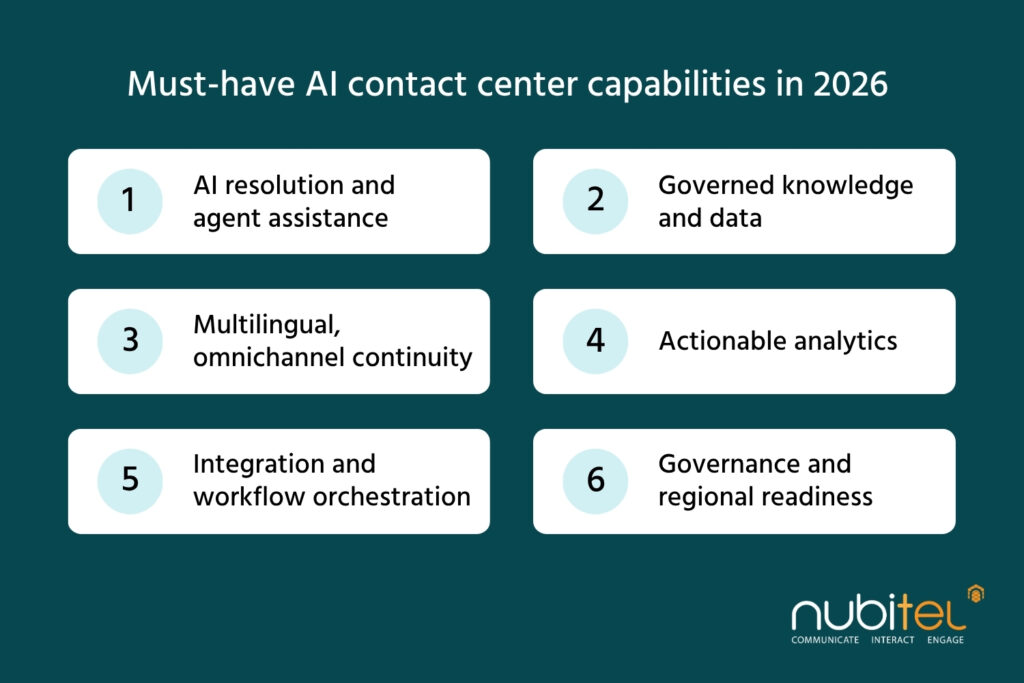
Most AI contact center platforms now offer core capabilities such as AI agents, agent assistance, analytics, and automation. For the best AI contact center solutions in SEA, these capabilities must also meet the region’s operational, language, integration, and governance requirements.
1. AI resolution and agent assistance
AI agents should understand intent, use approved information, update authorised systems and escalate with full context. Meanwhile, agent assistance should provide timely knowledge, next-best actions and summaries without creating extra correction work.
Buyers should test a complete journey, including authentication, API failure and human handover.
2. Governed knowledge and data
Both AI agents and human agents need accurate, current information. Outdated or fragmented knowledge can produce inconsistent answers, regardless of how advanced the AI model appears.
For this reason, enterprises should look for content approvals, permissions, version control, source tracking, feedback loops, and expiry management.
3. Multilingual, omnichannel continuity
For Southeast Asian enterprises, language support affects service quality and growth.
Test every required language across speech recognition, text-to-speech, AI responses, agent assistance, and analytics. Also confirm that context survives when a customer moves between voice, chat, email, messaging and a human agent.
4. Actionable analytics
Conversation analytics should turn customer interactions into useful operational insights. Core capabilities include transcription, summaries, topic and sentiment detection, automated scorecards, and quality or compliance monitoring.
However, dashboards alone do not improve performance. The platform should connect insights to coaching, alerts, case updates, compliance reviews, or process improvements. This allows the business to act on recurring issues instead of simply reporting them.
5. Integration and workflow orchestration
AI cannot resolve a request without access to the systems where customer data and business processes reside. Therefore, the platform should integrate with CRM, ticketing, payment, order management, identity, knowledge, and workforce systems.
Do not evaluate integration based only on connector logos. Confirm what data the platform can read and update, which actions it can trigger, whether information flows in both directions, and how it handles errors or delays.
6. Governance and regional readiness
Enterprises need controls for data access, retention, permissions, human approval, audit trails and incident response.
In Southeast Asia, they should also verify country-level telephony, messaging channels, hosting options, disaster recovery and regional implementation support.
>>> Read more: AI in Contact Centers: Top 3 Solutions & 4 Benefits
Top 7 AI Contact Center Solutions for Southeast Asian Enterprises
This ranking assesses the best AI contact center solutions in SEA based on their fit for Southeast Asian deployments, rather than global market position alone. We prioritised regional delivery experience, multilingual capabilities, platform breadth, infrastructure, integration, governance, and scalability.
Nubitel ranks first for its strong combination of an integrated AI contact center platform, regional-language capabilities, and delivery experience across Asian markets. Buyers should still assess each vendor against their specific countries, channels, and regulatory requirements.
Solution | Best suited to | Main strengths | Southeast Asia consideration |
Nubitel | Regional enterprises seeking an integrated CX platform | Omnichannel CCaaS, multilingual AI agent, personalized AI voice agent, real-time agent assist, knowledge management system, low-code workflow design, intelligent routing, conversation analytics, CRM and API integration | Nubitel has teams across Singapore, Malaysia, Indonesia, Vietnam, and India, with AI capabilities designed for Asian languages and regional contact center operations. |
Genesys Cloud CX | Large multinational contact centers | AI agents, copilots, journey orchestration, routing, analytics, workforce engagement, and knowledge tools | Genesys has a Singapore core cloud region and Singapore presence. Validate telephony, AI features, language support, and data-processing requirements for each target country. |
NiCE CXone | Large, complex, or regulated operations | AI automation, copilots, analytics, quality management, workflow tools, and workforce optimisation | CXone launched in Singapore in 2022 with a dedicated local infrastructure team supporting APAC. Confirm country-level telephony, language, data residency, and implementation coverage. |
Amazon Connect | AWS-based enterprises with strong technical and cloud teams | Agentic self-service, agent assist, conversational analytics, routing, campaigns, workforce tools, and AWS-native integrations | Amazon Connect is available in AWS Asia Pacific (Singapore). Feature, language, and outbound-calling availability vary by service and destination country. |
Cisco Webex Contact Center | Enterprises already using Cisco and Webex | AI Agent, AI Assistant, omnichannel engagement, interaction analytics, routing, and Webex collaboration | Cisco states that Webex Contact Center is available across several ASEAN markets and supports regional deployment through Singapore infrastructure. Confirm exact country, PSTN, AI, and residency availability. |
Five9 | Enterprises modernising inbound and outbound contact centre operations | AI voice agents, agent assist, omnichannel routing, CRM integrations, analytics, and workforce engagement | Five9 has a Southeast Asia headquarters in the Philippines. Verify hosting location, local-number coverage, AI-language capability, and support arrangements by market. |
Talkdesk | Enterprises seeking configurable workflows and industry-focused CX packages | AI agents, industry clouds, omnichannel engagement, analytics, and workforce tools | Talkdesk’s announced APAC Regional Cloud is in Australia, while the company has dedicated teams in Singapore, the Philippines, and Thailand. Confirm country-specific telephony and data-residency fit. |
1. Nubitel: Best Overall for Southeast Asian Operations
Nubitel offers the clearest balance of regional delivery and end-to-end capability in this comparison. Our teams are based in Singapore, Malaysia, Indonesia, Vietnam and India, giving customers direct access to implementation expertise shaped by Asian languages and operating environments.
Our ecosystem brings together:
- Nubitel CX for omnichannel cloud customer engagement across voice, chat, email, and social media
- Nubitel AI Agent for automated voice and digital conversations
- Nubitel Voice Hub for natural, personalized corporate voice signatures across SEA languages
- Nubitel AI Agent Assist for contextual knowledge and suggested actions during live interactions
- Nubitel Knowledge Management System for a centralized and governed source of data
- Nubitel Dialogue Manager for low-code workflow design, API actions, and human escalation
- Nubitel Conversation Analytics for sentiment, topics, quality, compliance indicators, and performance insights
This integrated approach reduces the need to assemble separate automation, knowledge and analytics products. Nubitel Agent Assist is available in English, Bahasa Melayu, Bahasa Indonesia, Thai and Vietnamese, while Nubitel Voice Hub covers regional languages including English, Bahasa Malaysia, Bahasa Indonesia, Mandarin, Thai, Vietnamese and Tamil. Language coverage should still be verified for every product and use case.
Strengths: Regional delivery, broad AI capabilities and continuity between automated and human service.
Watch-outs: Nubitel has a smaller global marketplace than the largest multinational vendors. Buyers should confirm country-specific hosting, telephony, data residency and module-level language support.
2. Genesys Cloud CX: Best for Large Multinational Enterprises
Genesys provides one of the broadest enterprise platforms in this comparison, spanning AI agents, agent copilots, routing, knowledge, journey orchestration, analytics and workforce engagement.
Its Singapore core cloud region strengthens its suitability for Asian deployments, while its Jakarta satellite region supports local call-recording storage and regional voice quality.
Strengths: Enterprise breadth, global ecosystem and advanced orchestration.
Watch-outs: Licensing, AI-token consumption and governance can become complex across large deployments. Buyers should verify language, telephony and AI availability by country.
3. NiCE CXone: Best for Workforce and Quality Management
NiCE CXone is particularly strong in workforce management, automated quality management, interaction analytics and operational governance. Its AI capabilities support customer self-service, agents, supervisors and back-office workflows.
NiCE launched CXone in Singapore in March 2022 and stated that the platform was supported by a dedicated local infrastructure team for Asia-Pacific organisations.
Strengths: Mature workforce, quality, compliance and analytics capabilities.
Watch-outs: Enterprise deployments can involve multiple products, licences and implementation workstreams. Country-level telephony, data residency and language support still require confirmation.
4. Amazon Connect: Best for Composable AWS Architectures
Amazon Connect suits enterprises that want to build a customised contact center around AWS. It supports routing, self-service, agent assistance, conversational analytics, campaigns, customer profiles and workforce capabilities.
The service is available in the AWS Asia Pacific (Singapore) Region, although individual features and languages vary by region.
Strengths: Architectural flexibility, AWS-native integration and usage-based consumption.
Watch-outs: The platform requires cloud architecture, security and integration expertise. Moreover, Singapore instances do not receive default outbound access to every Southeast Asian country; additional destinations may require approval and remain subject to local restrictions.
5. Cisco Webex Contact Center: Best for Cisco-Based Enterprises
Cisco combines cloud contact center operations with Webex collaboration, AI Agent, AI Assistant, digital engagement, routing and interaction analytics.
Its Singapore data center supports customers across Singapore, Indonesia, Malaysia, the Philippines, Thailand, Vietnam and other Asian markets, giving Cisco one of the clearest documented regional infrastructure positions in this comparison.
Strengths: Regional infrastructure and close integration with Cisco collaboration, calling, networking and security products.
Watch-outs: The business case is strongest for organisations already invested in Cisco. Buyers should verify PSTN, recording, AI processing and language availability.
6. Five9: Best for Inbound and Outbound Modernisation
Five9 combines inbound, outbound and blended contact center capabilities with AI agents, agent assist, CRM integrations, workflow automation and workforce engagement.
The company has maintained its Southeast Asian headquarters in the Philippines since 2006, providing a documented regional commercial presence.
Strengths: Established outbound capabilities, embedded AI and broad operational functionality.
Watch-outs: Five9’s public regional information does not by itself establish local hosting, telephony or AI-language coverage across ASEAN. These areas should be confirmed for each market.
7. Talkdesk: Best for Configurable Industry Workflows
Talkdesk provides AI agents, low-code workflow automation, analytics and industry-specific packages for sectors including financial services, healthcare, retail and travel.
It has teams in Singapore, the Philippines and Thailand, while its APAC Regional Cloud is located in Australia.
Strengths: Configurable automation, industry packages and extensive AI-language documentation.
Watch-outs: Australian hosting may not satisfy every Southeast Asian data-residency or latency requirement. Buyers should confirm where recordings, analytics and AI processing occur.
How to Shortlist and Validate an AI Contact Center Solution
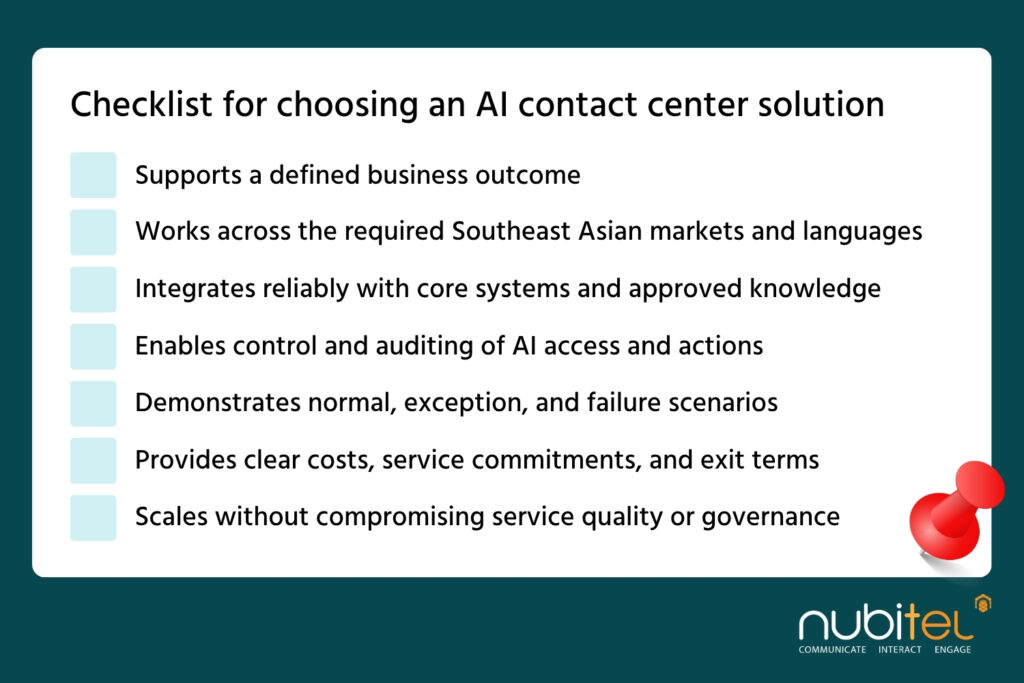
The best AI contact center solutions in SEA should deliver measurable value, operate reliably across target markets, and remain under enterprise control. At Nubitel, we recommend a three-step approach – Define, Prove, and Scale – to help organisations make a confident, evidence-based decision.
Step 1. Define
First, select two or three customer journeys with clear value and manageable risk. For each journey, define:
- The target business and customer outcomes
- The required markets, languages and channels
- The systems, data and knowledge involved
- The actions the AI may complete or escalate
Then, shortlist vendors that meet every mandatory requirement.
Step 2. Prove
Next, give each vendor the same representative data, workflows, and success criteria. Test:
- A multi-step request involving a system update
- A multilingual conversation
- A switch between channels
- An authentication or approval step
- A system failure
- A human handover with full context
Measure correct resolution, response time, integration reliability, repeat contacts and escalation quality. An interaction should count as automated only when the AI resolves it without avoidable rework.
In addition, compare implementation effort, total operating cost, regional support and contractual responsibilities.
Step 3. Scale
Once the selected platform meets the agreed targets, launch one controlled use case. Before launch, approve its knowledge sources, define its action limits and assign monitoring responsibilities.
Finally, expand by journey, language, channel or market only after performance, security and customer experience remain stable.
Making the Right AI Contact Center Choice in SEA
There is no universal winner among the best AI contact center solutions in SEA. The right platform must resolve priority journeys, work with existing systems and perform reliably across required markets.
Nubitel brings multilingual AI, agent assistance, governed knowledge, analytics, omnichannel engagement, and so much more into one regional solution. Contact us today to discuss your requirements.
FAQs
Does AI replace human agents in contact centers?
No. AI handles routine requests and assists agents, while people manage complex, sensitive or high-value interactions. The strongest model combines automation with clear human escalation.
What is the typical ROI timeline for AI contact center software?
ROI varies by call volume, use case, automation accuracy and implementation cost. Instead of relying on vendor benchmarks, calculate payback using your current costs and proof-of-concept results.
How long does it take to implement an AI contact center solution?
A focused pilot may take several weeks, while an enterprise rollout can take several months. Integrations, data readiness, security reviews and the number of markets usually determine the timeline.
Can AI contact center platforms handle multiple languages?
Yes, but performance varies by language and capability. Test speech recognition, text-to-speech, AI responses, agent assistance and analytics separately for every required language and accent.
What should enterprises test during a proof of concept?
Test task completion, CRM updates, multilingual performance, context preservation, escalation, access controls and failure recovery. Use identical scenarios and scoring for every vendor.