

Contact centres can’t improve what they can’t see. When reviews cover only a sample of customer conversations, recurring service issues, compliance risks and coaching opportunities can go unnoticed.
AI-powered conversation analytics analyzes voice and digital interactions at scale, helping teams uncover service gaps, monitor quality and evaluate agent performance against defined standards.
Gartner projects that by 2028, 75% of service and support organizations will have reduced human agent QA teams by more than 50% through conversation analytics technology. This strategic planning assumption highlights the potential of automated evaluation, while human oversight remains essential for contextual judgment and coaching.
So, what separates a platform that simply analyzes conversations from one that drives measurable improvements? This guide explores the essential features and implementation practices to consider when choosing conversation analytics software.
Table of Contents
ToggleWhat is conversation analytics?
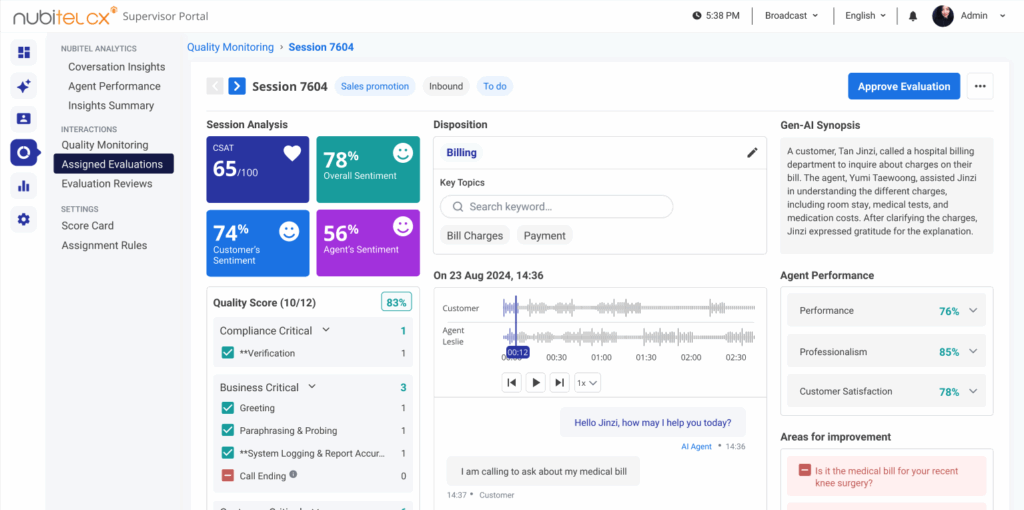
Conversation analytics uses AI to analyze natural-language interactions between customers and an organization, generating insights that support service improvement and decision-making.
Conversation analytics software can process voice and text interactions across supported channels, including calls, live chat, messaging and email. Analysis may take place after an interaction or in real time, depending on the platform.
Common outputs include searchable transcripts, customer sentiment and topic insights, interaction scorecards, potential compliance alerts, agent performance assessments and AI-generated summaries.
Why is customer conversation analytics important?
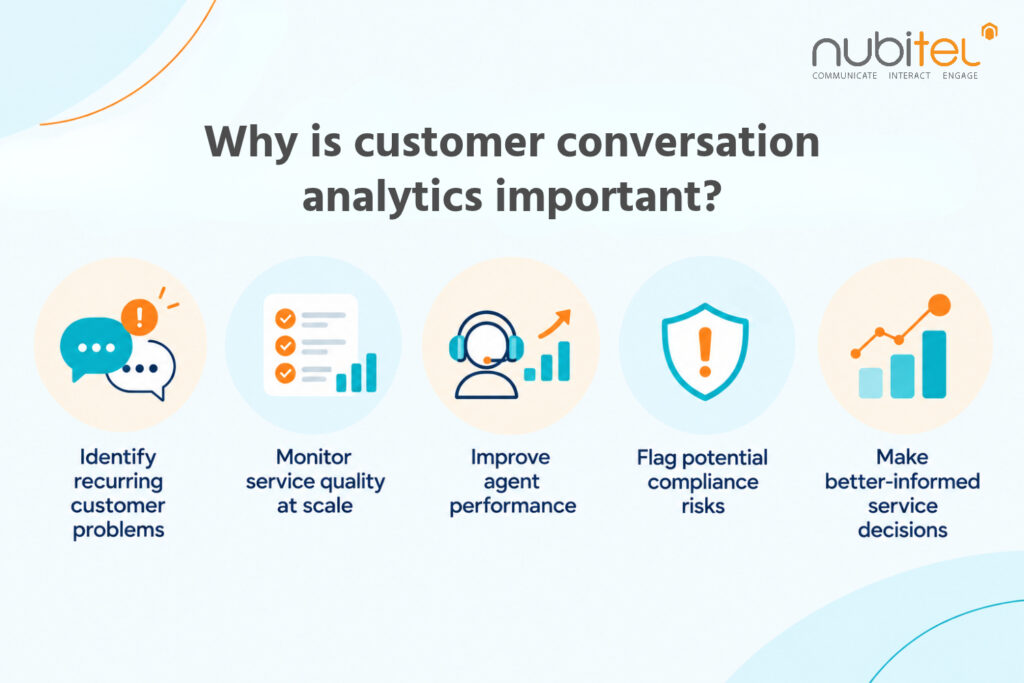
Analyzing customer conversations helps organizations understand not only what happened during an interaction, but also the recurring factors behind service outcomes.
Identify recurring customer problems
Repeated complaints, unresolved questions and negative feedback can reveal friction in the customer journey. Conversation analytics helps teams detect these patterns and investigate their causes, informing improvements to service processes and customer-facing information.
Monitor service quality at scale
Manual reviews cover only a portion of interactions. Automated evaluation can broaden monitoring coverage and help teams identify conversations that warrant closer review.
Improve agent performance
Interaction-level insights help supervisors identify performance gaps, recognize effective behaviours and provide agent coaching based on specific examples rather than relying solely on aggregate scores.
Flag potential compliance risks
AI can detect possible deviations from required procedures, such as missed disclosures or policy-related concerns. These alerts help prioritize investigations, but findings should be validated before being treated as confirmed violations.
Make better-informed service decisions
Trends in contact reasons, sentiment and resolution outcomes can expose problems affecting many customers. Teams can use these findings to prioritize process improvements rather than addressing each complaint in isolation.
How does conversation analytics work?
Conversation analytics follows 4 key stages to transform customer conversations into actionable insights.
Data cleanup
The first stage involves cleansing raw data by removing irrelevant elements such as filler words, special characters, and inconsistent grammar or punctuation. This ensures uniformity and prepares the text for accurate analysis. This phase is crucial for making noisy, unstructured data understandable by AI models.
Understanding language
Natural language processing (NLP) plays a vital role in interpreting the meaning of words, phrases, and sentences. NLP helps contextualize expressions and understand intent, tone, and sentiment within the conversation. It allows platforms to recognize domain-specific terminology and nuances in different languages or dialects.
Finding patterns
Once the language is processed, machine learning algorithms detect recurring patterns such as commonly asked questions, repeated complaints, or frequently used keywords. Over time, these algorithms become more effective by learning from vast datasets. This supports trend detection, escalation prediction, and proactive issue resolution.
Reporting insights
Finally, the system visualizes insights through dashboards, alerts, or reports. These summaries point out service gaps, agent strengths, and areas where customer experience can be improved. This visualization layer enables informed decision-making for supervisors and business leaders.
Essential features of conversation analytics software
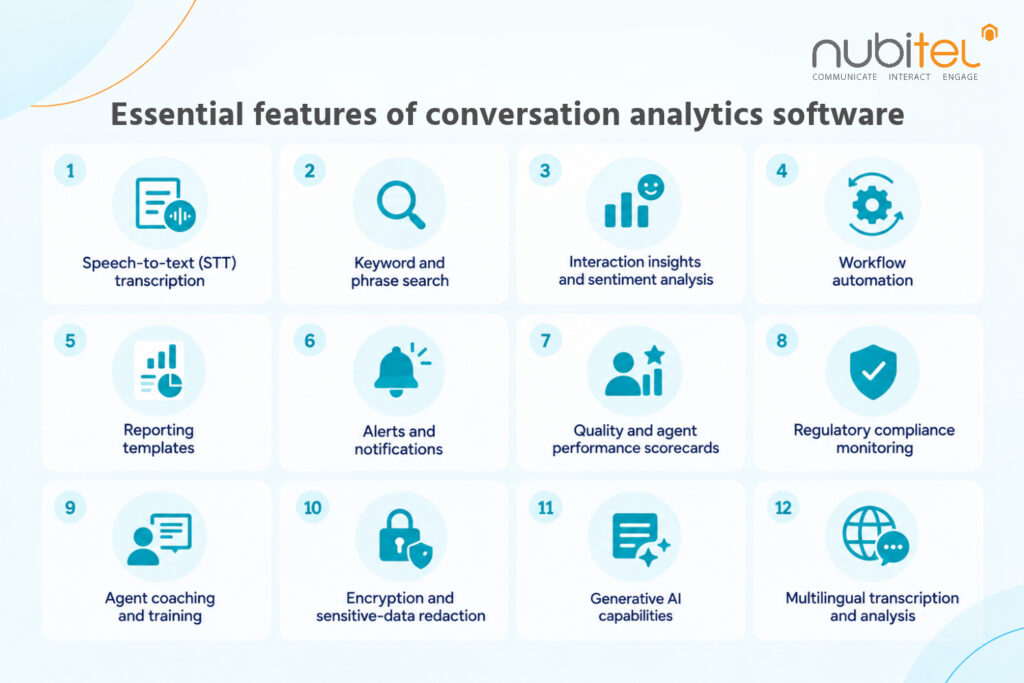
A conversation analytics platform needs a reliable analytical foundation, capabilities to support quality monitoring and compliance, and mechanisms to turn insights into action. Here are 12 core features to look for in conversation analytics software.
- Speech-to-text (STT) transcription: Converts voice recordings into searchable text for analysis.
- Keyword and phrase search: Helps reviewers find relevant interactions without manually listening to every recording.
- Interaction insights and sentiment analysis: Identifies recurring topics, customer concerns and sentiment patterns.
- Workflow automation: Triggers defined actions in response to analytical findings.
- Reporting templates: Visualizes insights and evaluation results in structured reports.
- Alerts and notifications: Flags issues that require attention or follow-up.
- Quality and agent performance scorecards: Evaluates interactions against defined criteria and performance standards.
- Regulatory compliance monitoring: Identifies potential deviations from required procedures.
- Agent coaching and training: Supports targeted feedback and performance development.
- Encryption and sensitive-data redaction: Helps protect transcripts and redact sensitive information from call recordings.
- Generative AI capabilities: Includes automated call and text summaries, call disposition and knowledge article generation from interaction transcripts.
- Multilingual transcription and analysis: Supports the languages needed to serve the organization’s customer base.
How to choose the right conversation analytics platform
A platform’s feature list is only a starting point. To ensure it delivers reliable insights and measurable value, evaluate its accuracy, business fit, implementation requirements and long-term cost.
Analytical accuracy
Test STT performance using real recordings that reflect your customers’ accents, audio conditions and industry-specific terminology. Because transcription errors can affect every subsequent analysis, define minimum accuracy requirements and validate them through a proof of concept.
Business and ecosystem fit
Match the platform to your priority use cases, required channels and existing technology ecosystem, including telephony and CRM. Assess whether it can integrate with customer journey analytics, voice-of-the-customer and other relevant systems when a broader customer view is needed.
Security and governance
Evaluate data storage, encryption, sensitive-data redaction and access controls against your organization’s security and privacy requirements. Define how AI-generated evaluations will be reviewed, how exceptions will be handled and who is accountable for evaluation decisions.
Implementation and usability
Assess integration complexity, resource requirements and ease of use for supervisors, analysts and monitoring teams. Start with use cases that require minimal integration, then expand as the platform proves its value.
Total cost and scalability
Look beyond the initial license or subscription. Conversation processing, GenAI usage, external AI agents, API calls and data storage may incur separate charges. Model expected usage and high-volume scenarios to understand the total cost before committing.
Common challenges in implementing conversation analytics
To make conversation analytics work effectively in practice, organizations should plan for its various challenges, from data protection, system integration, and analytical accuracy to user adoption.
Protecting customer data
Conversations may contain personal or sensitive information. Assess applicable data protection requirements, access controls, encryption, redaction and retention policies before deployment.
Integrating with existing systems
Connecting analytics to telephony, CRM and other systems can require technical work. Confirm integration capabilities, data requirements and implementation effort early.
Maintaining analytical accuracy
Accents, background noise, multilingual conversations and specialist terminology can affect transcription and downstream analysis. Test with representative interactions and review false alerts, missed issues and inconsistent scores.
Managing organizational change
Automated evaluation changes how agents receive feedback and how monitoring teams allocate their time. Explain evaluation criteria, train users and retain human oversight for decisions requiring contextual judgment.
Best practices for a successful conversation analytics strategy
1. Define measurable objectives
Set clear goals, such as expanding monitoring coverage, improving compliance or reducing manual review effort. Establish baseline metrics to assess progress.
2. Start with a focused pilot
Test one use case, channel or team first. Validate transcription accuracy, evaluation criteria, workflows and reporting before scaling.
3. Involve key stakeholders
Engage QA managers, supervisors, agents, compliance specialists and IT teams to ensure the platform meets practical requirements.
4. Prioritize data quality
Review audio quality, transcript accuracy, interaction metadata and evaluation criteria. Confirm that required knowledge resources and customer information are available.
5. Keep humans in the loop
Allow qualified reviewers to validate AI-generated evaluations, adjust scores when appropriate and document decisions. Automation should expand monitoring coverage without removing accountability.
6. Refine continuously
Track business outcomes, transcription performance and evaluation consistency. Use review findings and user feedback to improve criteria, workflows and implementation over time.
How Nubitel Conversation Analytics helps scale quality monitoring
Nubitel Conversation Analytics helps contact centres evaluate 100% of interactions, uncover performance gaps and turn conversation data into targeted improvements, while keeping human judgement in the loop.
Identify issues before they escalate
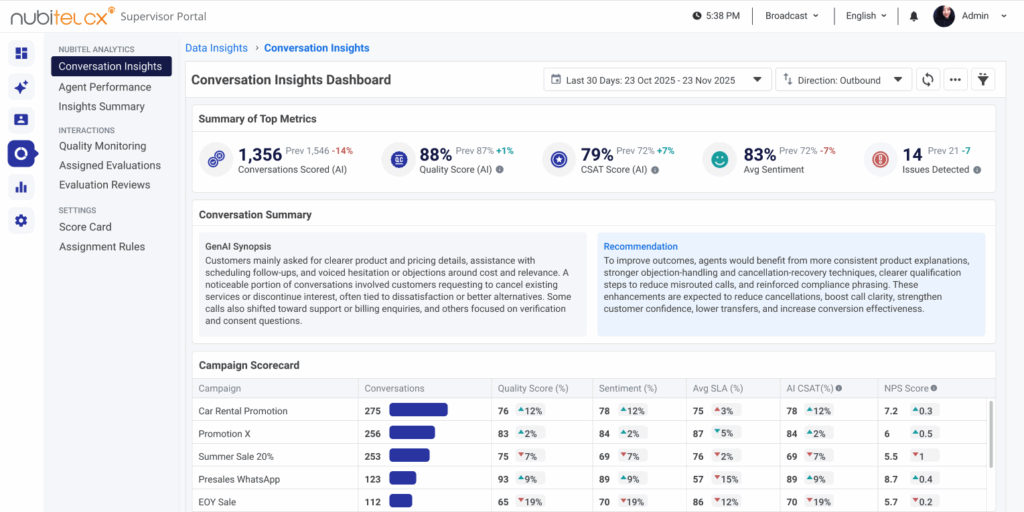
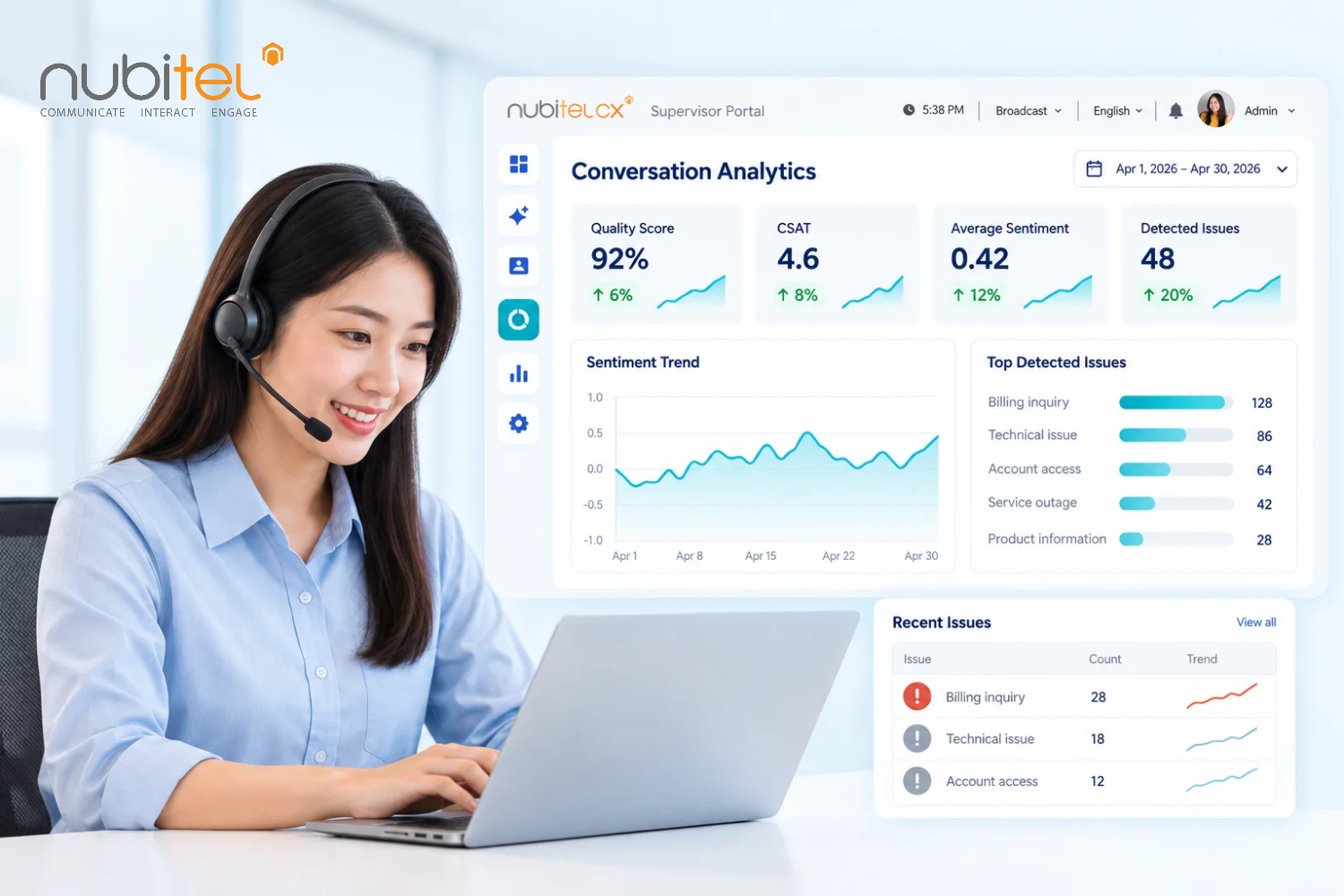
Get a centralized view of quality scores, CSAT, average sentiment, detected issues and campaign performance. Track sentiment trends and recurring problems in one dashboard to help supervisors spot emerging issues faster and gain a clearer picture of contact centre performance.
Align AI evaluations with your business standards
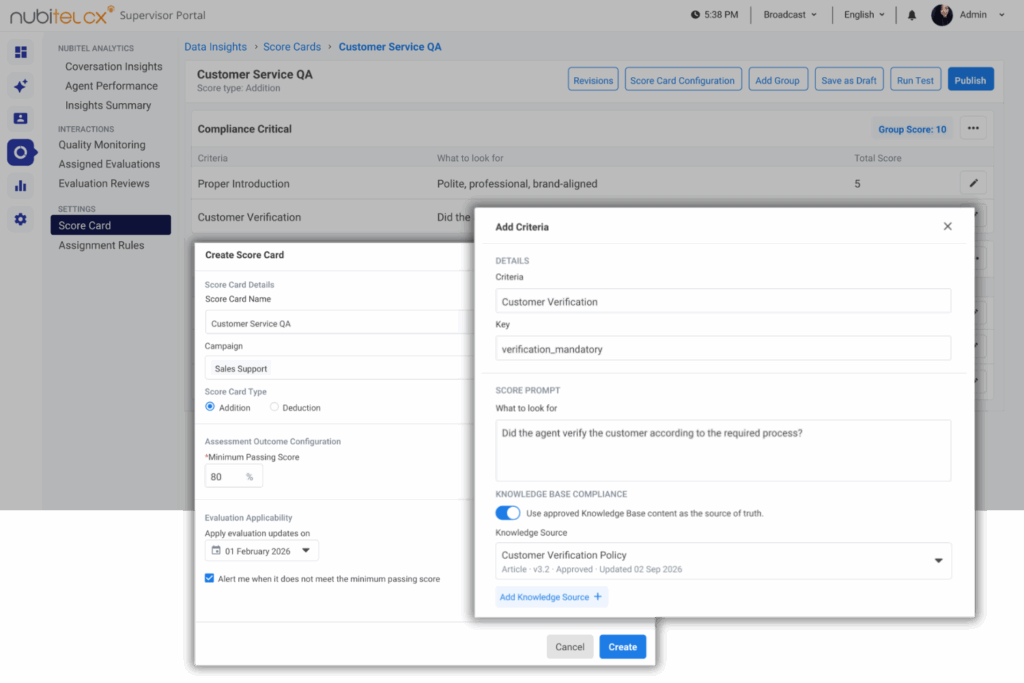
Create personalized AI Score Cards with custom criteria, score prompts, scoring values, minimum passing thresholds, failure rules, etc., tailored to your quality standards. For criteria that depend on business policies or procedures, enable Knowledge Base Compliance and select approved knowledge sources as the source of truth for evaluation.
This helps AI evaluate interactions against both your QA framework and the latest approved business knowledge – supporting more consistent, policy-aligned, and reliable quality assessments.
Make agent coaching more targeted
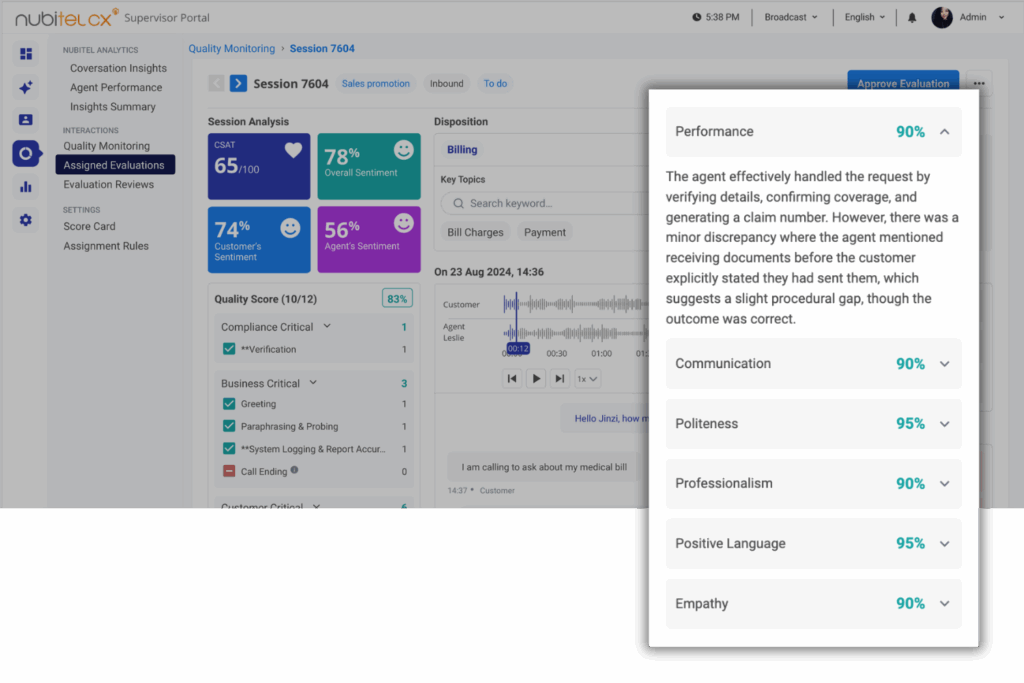
Use AI-generated scores and explainable performance insights to pinpoint specific evaluation failures, recurring weaknesses and agent development needs. Supervisors can prioritize coaching based on actual conversation evidence, making feedback more focused and improvement efforts more effective.
Reduce manual evaluation workload
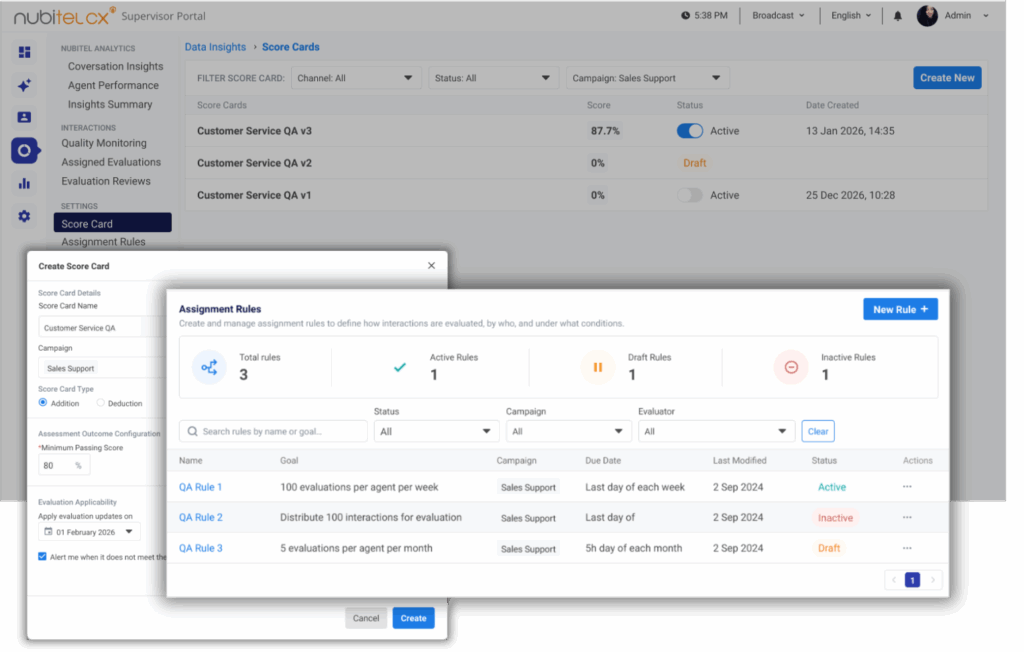
Define how interactions are distributed for evaluation by setting the evaluation frequency, number or percentage of interactions, due dates, assignment pool, and overdue reassignment rules. Apply a selected scorecard and version to each rule, helping teams distribute QA work consistently, keep evaluations on schedule, and reduce manual assignment effort.
Maintain control over AI-generated evaluations
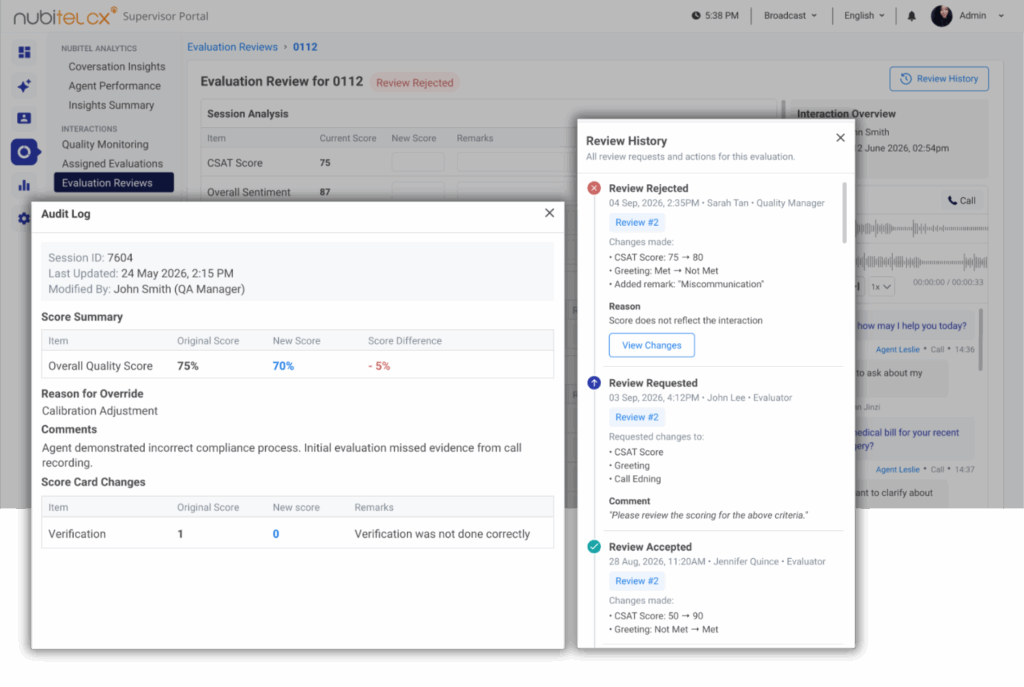
Human reviewers can examine AI assessments, override scores with documented reasons, exclude unsuitable interactions and track changes through Review History. This helps teams validate results and maintain accountability.
Expand quality monitoring across languages
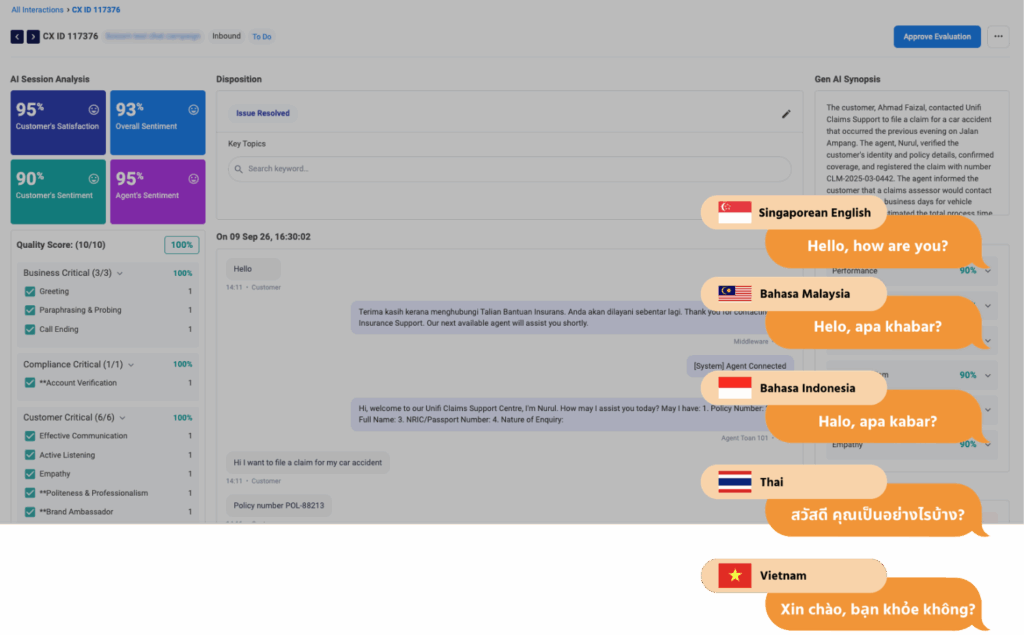
With support for 50+ languages and the ability to detect and support up to two languages simultaneously in a conversation, Nubitel Conversation Analytics helps organizations assess service quality and identify customer concerns across multilingual markets.
Turn customer conversations into actionable insights with Nubitel Conversation Analytics
Conversation analytics helps contact centres move beyond limited quality assurance samples to uncover recurring service issues, identify performance gaps and make data-driven decisions that improve service quality.
Nubitel Conversation Analytics evaluates 100% of interactions, aligns AI-powered evaluations with your own business standards and keeps human judgement in the loop. With broader evaluation coverage and actionable performance insights, your team can strengthen quality monitoring, target coaching more effectively and maintain control over evaluation outcomes.
Ready to scale quality monitoring with greater visibility and control? Contact us to experience Nubitel Conversation Analytics firsthand.
FAQs
Can Nubitel Conversation Analytics evaluate 100% of interactions?
Yes. Nubitel Conversation Analytics is designed to evaluate 100% of eligible customer interactions, helping contact centres expand quality coverage beyond sample-based manual reviews.
Can AI Score Cards be customized to our quality monitoring criteria?
Yes. Nubitel Conversation Analytics lets you configure evaluation criteria, scoring rules, passing thresholds and critical conditions to align assessments with your organization’s quality standards.
Can teams review or adjust AI-generated scores?
Yes. Nubitel Conversation Analytics includes Evaluation Review, Score Override, Interaction Exclusion, approval workflows and Review History, enabling teams to validate AI assessments, manage exceptions and maintain human oversight with traceable decisions.
Does Nubitel Conversation Analytics analyze multilingual conversations?
Yes. The platform handles more than 50 languages and can detect and process up to two languages simultaneously within a conversation.
Can Nubitel Conversation Analytics integrate with our CRM system?
Yes. Nubitel Conversation Analytics can connect with your existing CRM system to meet your integration needs. The integration approach depends on your CRM platform and the data flows required.