

Table of Contents
ToggleContact Center as a Service (CCaaS): From Cloud to AI-Ready CX
The shift to Contact Center as a Service (CCaaS) is gaining momentum as cloud platforms advance faster than premises-based solutions. Gartner projects CCaaS to reach 71% market penetration by 2030, driven in part by rapid advances in generative AI and agentic AI.
The rise of consumer and business AI assistants is also expected to increase machine-generated customer service interactions, contributing to a projected $19.2 billion in investment in AI-infused CCaaS in 2028.
As CCaaS evolves, the focus is expanding beyond cloud infrastructure to connected customer journeys, employee experiences, AI, knowledge, workflows and analytics. This makes platform selection increasingly important.
This guide explores how CCaaS works, the capabilities that matter, the value it can deliver, and key migration considerations.
What Is Contact Center as a Service?
Contact Center as a Service is a SaaS-based approach that enables organizations to manage customer interactions across multiple channels through a unified platform.
Modern CCaaS brings together the core capabilities needed to run and improve customer service, including interaction management, routing, AI, knowledge, workflows, analytics and integrations.
For business leaders, the strategic value of CCaaS lies in creating a scalable technology foundation for modern customer service. It enables organizations to add channels and AI capabilities, connect customer data with business systems, improve service performance, and respond to changing customer expectations.
This also changes how enterprises should evaluate CCaaS. Instead of asking only “Which features does the platform offer?”, leaders should ask how well those capabilities work together, integrate with the existing environment, and support measurable business outcomes.
How Does a Cloud Contact Center as a Service Work?
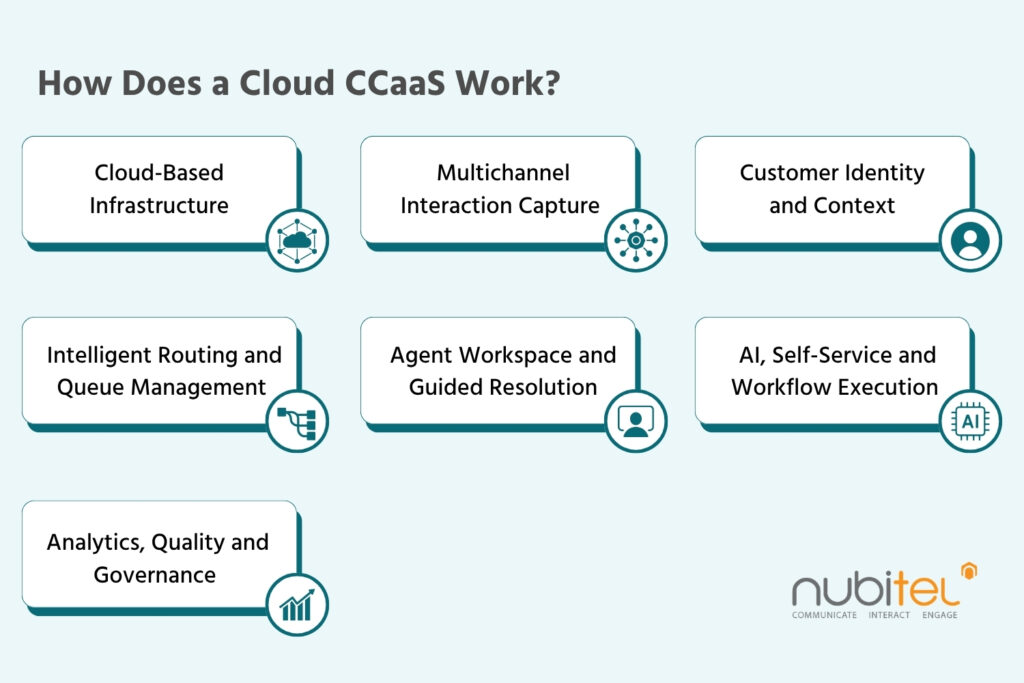
CCaaS can look simple from the outside because agents often work through a single browser-based interface. Yet, behind that interface, the platform coordinates channels, customer context, routing, AI, workflows, analytics, and governance.
1. Cloud-Based Infrastructure
The CCaaS provider hosts and manages the platform, allowing organizations to access contact center capabilities through the cloud instead of maintaining dedicated on-premises infrastructure.
This provides greater flexibility to support multiple locations, distributed teams, changing volumes and new service capabilities.
2. Omnichannel Interaction Capture
Customer interactions enter through voice and digital channels such as email, chat, SMS, messaging and social platforms.
A modern CCaaS platform does more than support multiple channels. It connects interactions to customer history and service context, so customers can move between channels without losing continuity.
3. Customer Identity and Context
The platform brings together relevant information from sources such as CRM, case management, orders, previous interactions, and knowledge systems.
This context helps determine what the customer needs, what has already happened and what should happen next, providing a stronger basis for routing and resolution.
4. Intelligent Routing and Queue Management
CCaaS uses business rules and real-time information to route interactions to the appropriate service path. Factors can include intent, skills, language, priority, customer context, service levels, and agent availability.
For supervisors, queue and workforce visibility helps monitor workloads, wait times, service levels, and agent capacity in real time.
5. Agent Workspace and Guided Resolution
Agents can access customer information, interaction history, knowledge, case details and workflow guidance from a unified workspace.
AI capabilities can further support agents with relevant knowledge, suggested responses, next-best actions and automated summaries, reducing time spent searching for information and switching between systems.
6. AI, Self-Service and Workflow Execution
AI is increasingly embedded across the modern contact center, supporting intent recognition, knowledge retrieval, agent assistance, conversation analysis, conversational self-service and after-interaction work.
More advanced CCaaS platforms can connect AI with business systems to perform defined tasks, such as retrieving information or updating records, within established rules and controls. Human escalation remains important when an interaction requires judgment or falls outside the AI’s scope.
7. Analytics, Quality and Governance
CCaaS brings together data from conversations, channels, agents, AI interactions and queues to support reporting, quality management, workforce planning, compliance and coaching.
The focus is moving beyond contact volume. Leaders need to understand why customers contact the business, where repeat contacts originate, which processes create friction, where agents need support, and where AI can add value safely.
This creates a continuous improvement cycle: Connect → Understand → Route → Resolve → Analyze → Improve.
Key Features to Look for in a Contact Center as a Service Platform
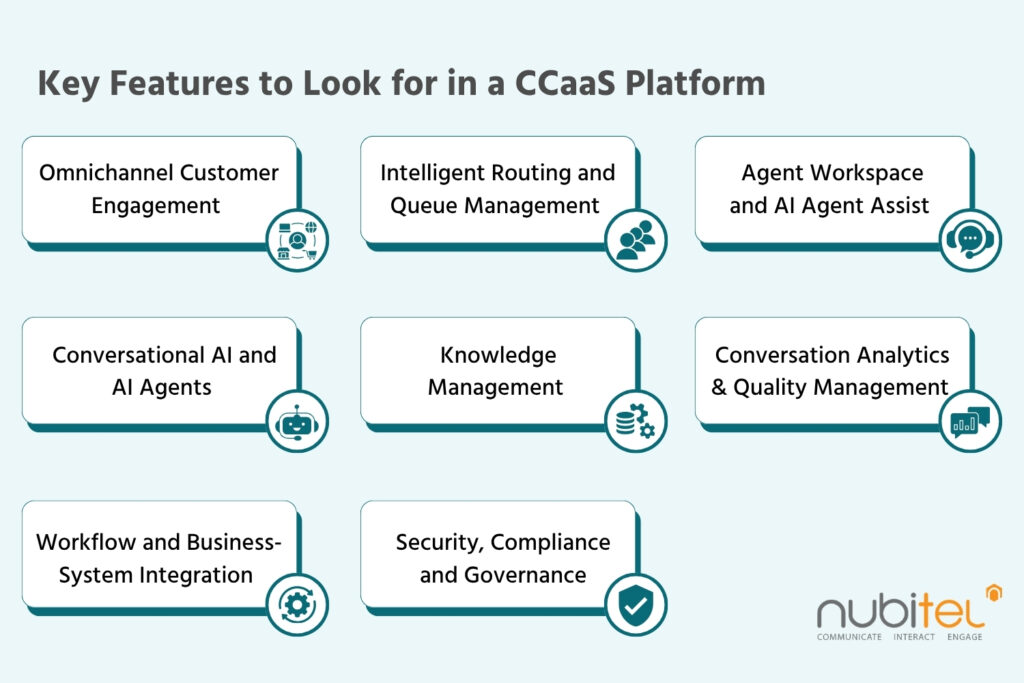
A strong contact center as a service solution should be evaluated by how well its capabilities work together to improve customer service, agent productivity and operational performance, not by the number of features on a product sheet.
1. Omnichannel Customer Engagement
Customers expect to engage through the channel most convenient to them. Opt for a CCaaS platform that connects voice and digital interactions while maintaining context across the customer journey.
Look for:
- Voice, chat, email and messaging
- Unified interaction history
- Cross-channel customer context
- Seamless self-service-to-agent handoff
- Inbound and outbound engagement
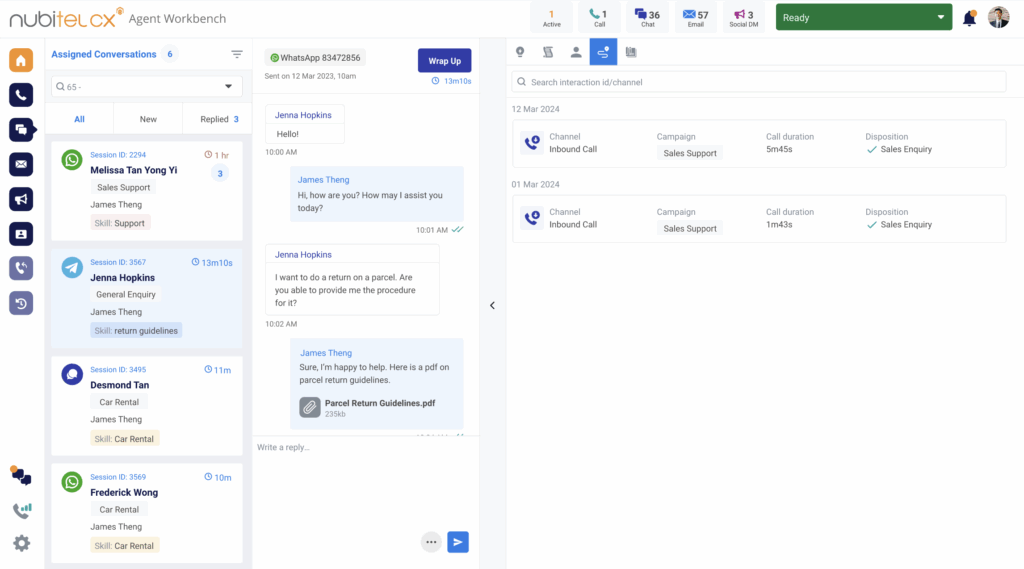
Nubitel CX provides the omnichannel customer engagement foundation, with Nubitel Agent Workbench included as the agent workspace for managing customer interactions across multiple channels. This gives agents a single environment to handle interactions rather than working across separate channel interfaces.
2. Intelligent Routing and Queue Management
Routing should go beyond sending an interaction to the next available agent. It should use business and customer context to determine the most appropriate destination.
Look for:
- Intent- and skills-based routing
- Language and priority-based routing
- Customer-context-based routing
- Queue and workload management
- Real-time service-level visibility
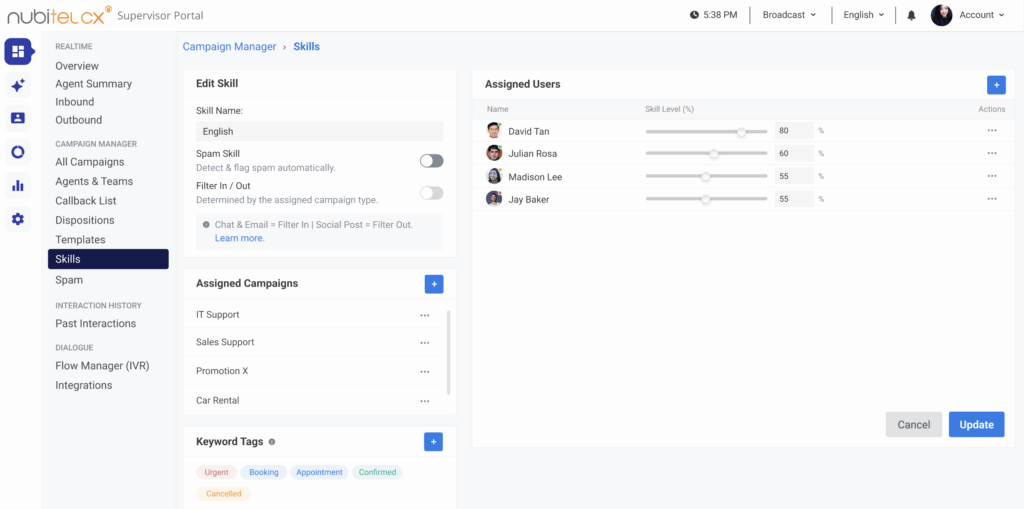
Nubitel provides Predictive & Intelligent Routing to direct interactions based on factors such as customer needs, skills and priority.
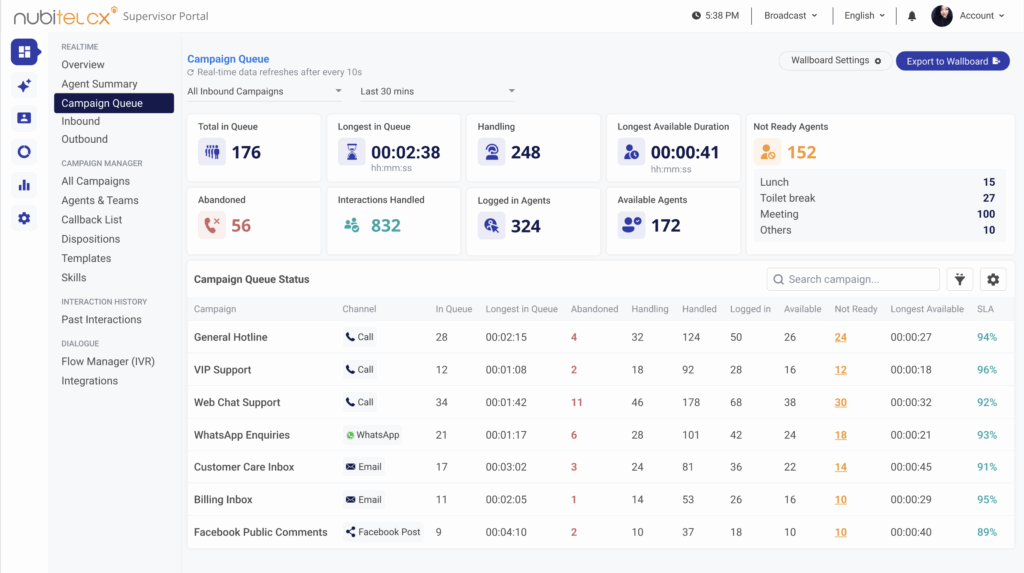
Nubitel Supervisor Portal provides real-time visibility into queues, agent capacity, waiting and abandoned interactions, service levels and campaign performance, helping supervisors respond to operational issues as they happen.
3. Agent Workspace and AI Agent Assist
The agent experience is a critical part of CCaaS because platform complexity ultimately affects the people delivering service.
Look for:
- Unified desktop
- Customer and interaction history
- Embedded CRM information
- Contextual knowledge
- Real-time suggestions
- Next-best actions
- Automated summaries and post-interaction support
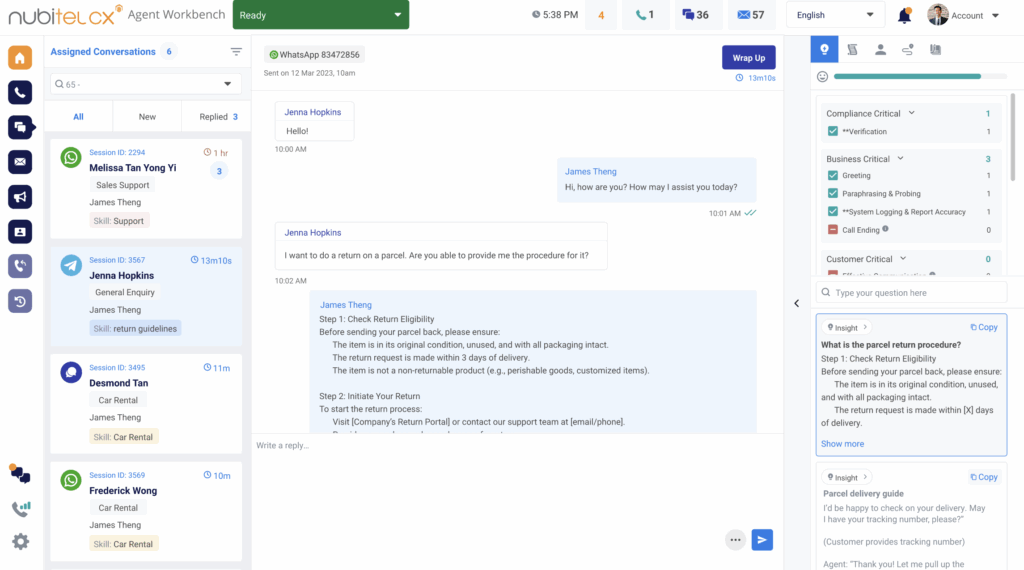
Within Nubitel CX, Agent Workbench provides the unified workspace, while Nubitel AI Agent Assist offers real-time, context-aware suggestions and retrieves relevant information from governed knowledge using RAG. Its CRM integration also helps agents access customer records without repeatedly switching applications.
4. Conversational AI and AI Agents
AI capabilities in CCaaS are increasingly moving beyond basic chatbots to support understanding, knowledge retrieval, conversation handling and defined service actions. When evaluating AI, enterprises should focus on how well it works with their knowledge, customer data and business systems.
Look for:
- Intent and context recognition
- Natural, context-aware conversations
- Responses grounded in enterprise knowledge
- Voice and digital interaction support
- Integration with third-party systems and APIs
- Configured actions and case workflows
- Testing, guardrails and human escalation
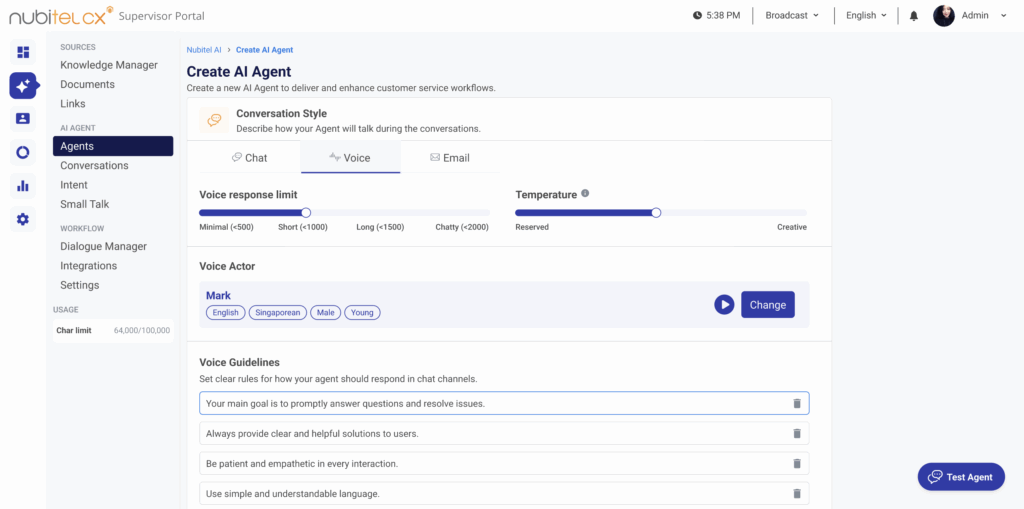
Nubitel AI Agent combines LLMs, RAG-powered knowledge, conversation intelligence, speech technologies and API integrations to understand customer needs, retrieve relevant information and carry out configured service actions.
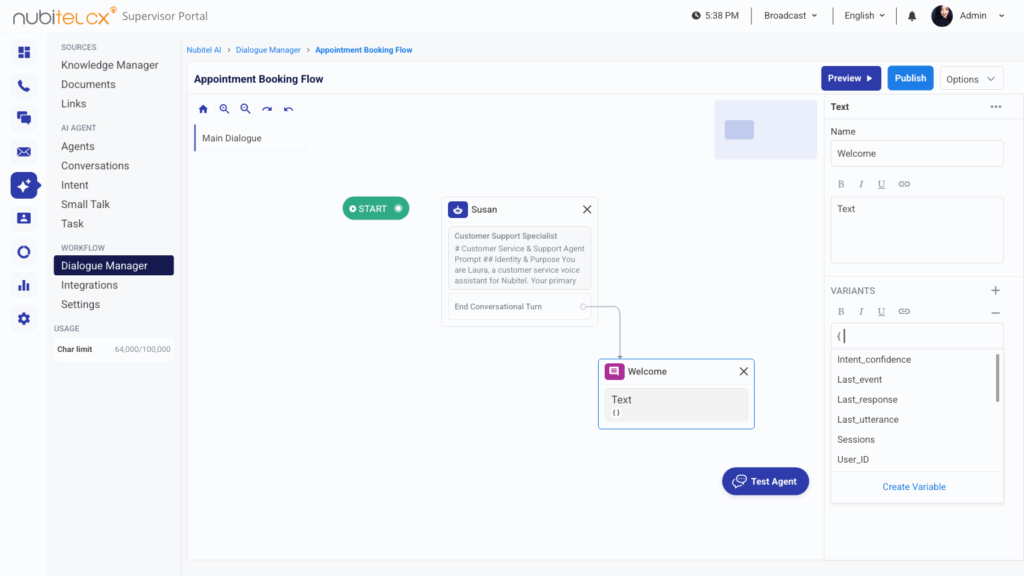
Through Nubitel Dialogue Manager, teams can visually define prompts, knowledge, tools, conditions and escalation paths, then test and refine the experience before deployment.
5. Knowledge Management
For AI-enabled customer service, knowledge serves as the foundation for accurate and consistent responses. Enterprises need to control what information AI and agents can access, while keeping that knowledge current and governed.
Enterprises should be able to control what information AI and agents can access and keep that information current.
Look for:
- Centralized and searchable knowledge
- Structured, AI-ready content
- Content governance and approval
- RAG-based retrieval
- Tools to maintain and improve knowledge
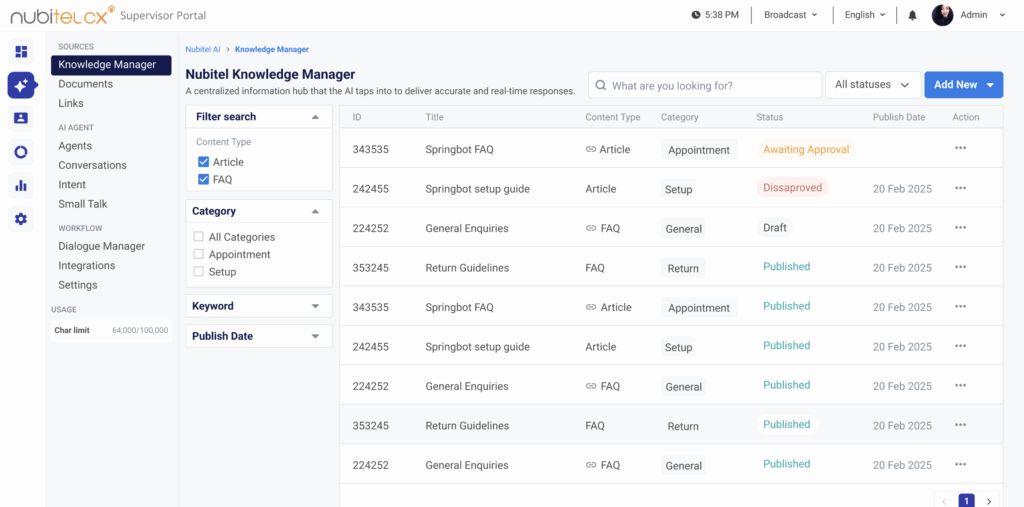
Nubitel Knowledge Management System turns all unstructured documents, web content and other enterprise information into a structured, centralized, governed knowledge hub. RAG retrieves relevant information from approved content for AI agents, while GenAI supports tasks such as summarization, FAQ generation, and knowledge organization. This gives both AI and human agents a common, governed knowledge foundation.
6. Conversation Analytics and Quality Management
Modern contact centers need to understand not only what happened in an interaction, but why it happened and where service can improve. Analytics should turn conversations into actionable intelligence across channels, agents and AI.
Look for:
- Sentiment and topic analysis
- Contact-driver and customer pain-point detection
- Automated quality evaluation
- Agent performance insights
- Trends, alerts and coaching opportunities
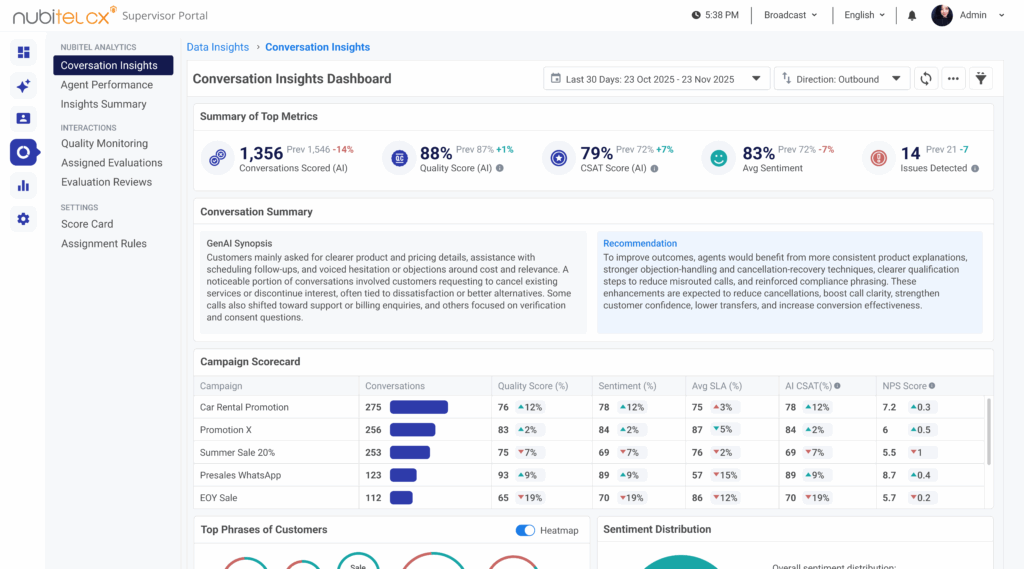
Nubitel Conversation Analytics analyzes call and chat transcripts using STT, NLP, NLU, GenAI and LLM technologies to identify sentiment shifts, recurring topics, customer pain points, compliance risks and performance gaps.
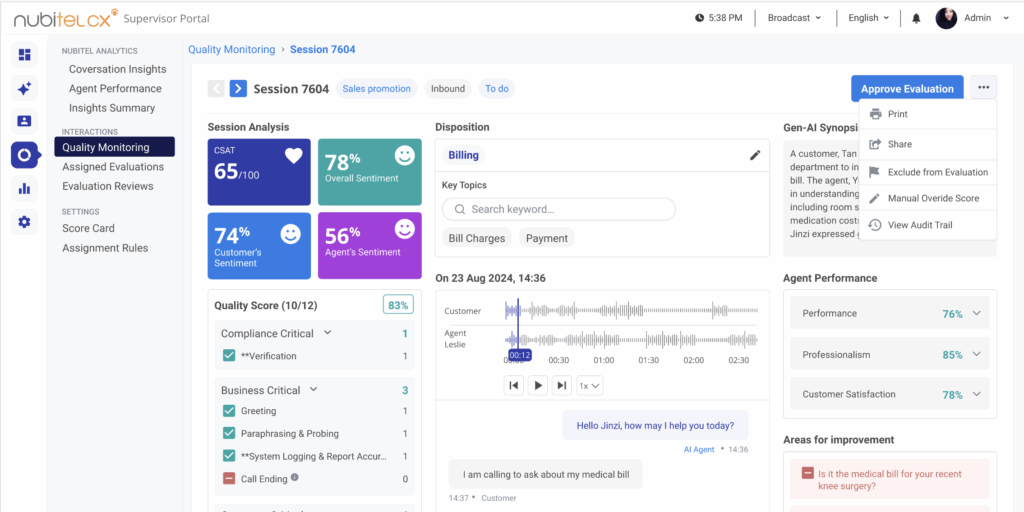
Nubitel’s AI-Powered Quality Monitoring automates 100% of interaction evaluations with intelligent AI scorecards, GenAI summaries, and data-driven agent performance insights. It helps supervisors consistently evaluate interactions, identify coaching opportunities, and make evidence-based decisions that drive agent performance and continuous quality improvement.
7. Workflow and Business-System Integration
Customer interactions often need to trigger actions beyond the contact center. Strong integration capabilities allow customer service to connect with the systems that support resolution.
Look for:
- CRM integration
- APIs and connectors
- Case creation and management
- Configurable workflows
- Backend system actions
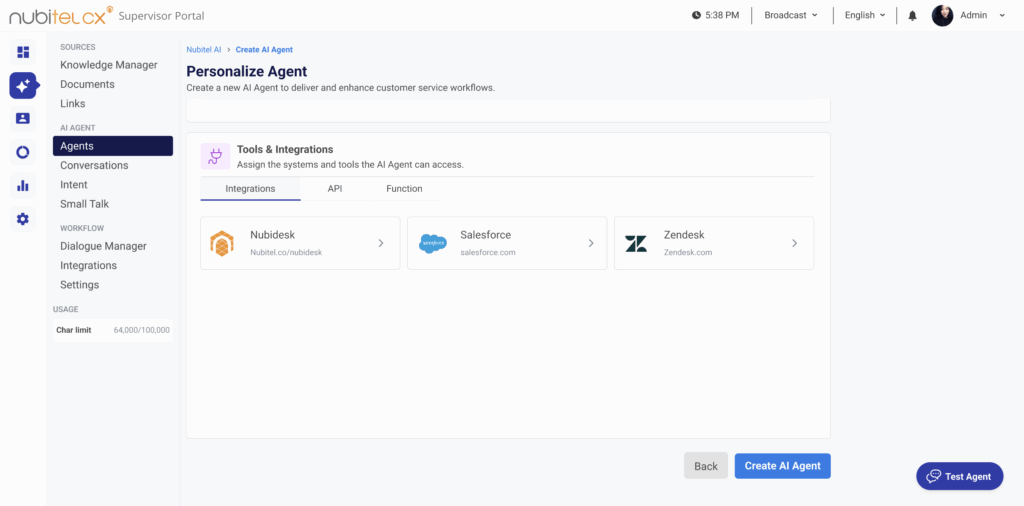
Nubitel connects these capabilities through Nubidesk, Nubitel Dialogue Manager, CRM Connector and API integrations, helping turn customer interactions into connected service workflows.
8. Security, Compliance and Governance
Security and governance should be built into CCaaS from the start, particularly when customer data, AI and business systems are connected.
Look for:
- Encryption and access controls
- Identity and authentication
- Data handling and retention
- AI guardrails and usage controls
- Auditability
- Relevant industry and regional requirements
Nubitel applies these controls across its customer engagement and AI ecosystem. Its cloud services use AES-256 encryption for data at rest, TLS 1.2+ for data in transit, role-based access controls, MFA and audit logs, alongside security reviews of third-party subprocessors.
For AI, Nubitel AI Agent provides layered guardrails across security, access, knowledge, behavior, content and actions. AI agents can be grounded in approved enterprise knowledge, connected only to configured tools and systems, and designed with defined interaction flows and escalation paths through Nubitel Dialogue Manager.
The same approach extends to Nubitel Knowledge Management System, where enterprise knowledge is governed and retrieved from approved content, and Nubitel Voice Hub, which provides controlled access, secure voice-file handling, encrypted transmission and centralized voice management.
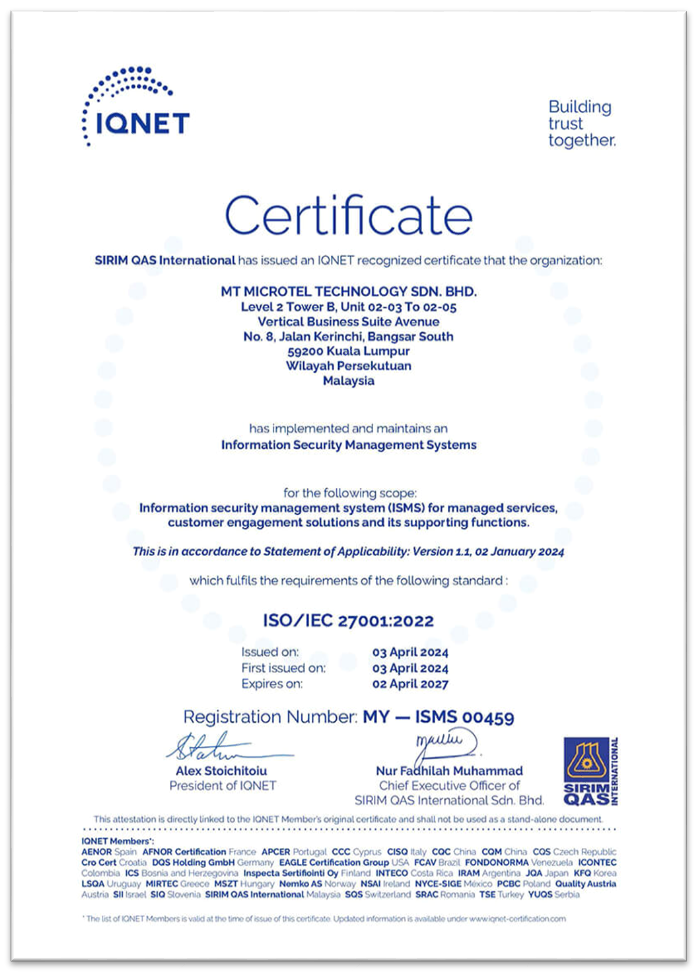
For enterprises operating in regulated environments, Nubitel’s platform is supported by ISO/IEC 27001:2022 and PCI DSS Level 1 certifications, providing an established security and compliance foundation.
What Are the Benefits of Contact Center as a Service?
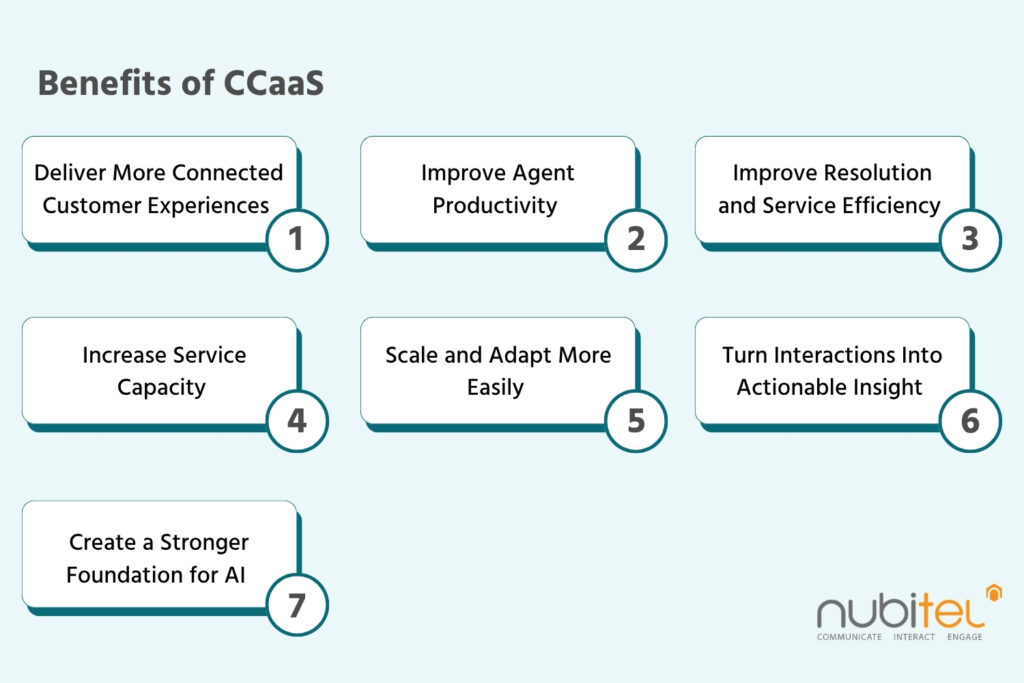
CCaaS delivers value beyond replacing legacy infrastructure. By connecting channels, customer data, agents, AI and service operations, it can improve both customer outcomes and contact center performance.
Deliver More Connected Customer Experiences
CCaaS connects customer interactions across voice and digital channels, helping preserve context as customers move between touchpoints. This reduces repetition and supports more consistent service.
Improve Agent Productivity
A unified workspace, centralized knowledge and AI Agent Assist reduce time spent switching systems, searching for information and completing manual after-interaction tasks. Agents can focus more on resolving customer needs.
>>> Read more: How AI Elevates Contact Center Agent Experience
Improve Resolution and Service Efficiency
Intelligent routing, customer context and relevant knowledge help send interactions to the right resource with the right information. This can reduce unnecessary transfers, repeat contacts and avoidable handling time.
Increase Service Capacity
Conversational AI and self-service can handle suitable routine enquiries, while human agents focus on more complex or sensitive cases. This allows organizations to serve more customers without relying solely on additional agent capacity.
Scale and Adapt More Easily
Cloud-based CCaaS makes it easier to add users, channels, locations and new service capabilities as requirements change, supporting multi-market and growing contact center operations.
Turn Interactions Into Actionable Insight
Create a Stronger Foundation for AI
Modern CCaaS brings together the data, knowledge, workflows and controls that AI depends on. This gives enterprises a more practical foundation for expanding AI capabilities while maintaining the governance and operational visibility needed at scale.
CCaaS Migration: What Enterprises Need to Plan For
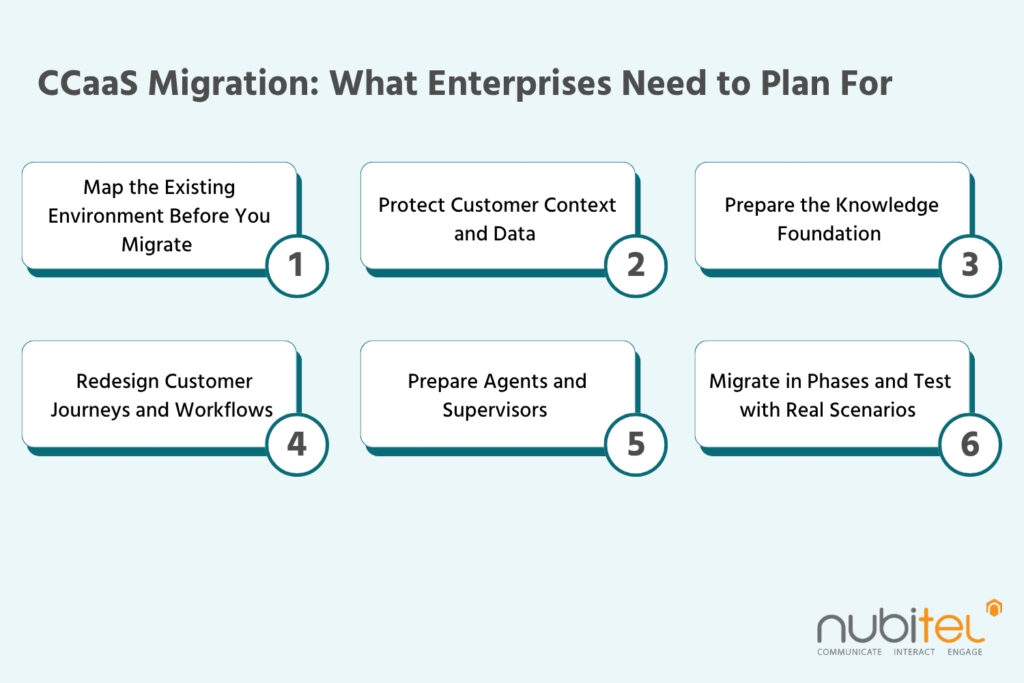
These benefits of CCaaS depend heavily on how the migration is planned. Moving to a new platform is an opportunity to rethink how customer service is delivered, measured, and scaled. As organizations continue moving from premises-based environments to CCaaS, migration planning needs to address technology, data, processes, and people together.
1. Map the Existing Environment Before You Migrate
Start with a complete view of the current operation: channels, IVR and call flows, routing rules, integrations, customer data, recordings, reporting and knowledge sources.
This helps identify hidden dependencies and separate what should be migrated, redesigned or retired. Rebuilding every legacy process in the new platform can carry old inefficiencies into the new environment.
2. Protect Customer Context and Data
CCaaS rarely operates alone. CRM, case management, identity, order, billing and other systems may feed customer context into the contact center.
Map these dependencies early, including data access, authentication, permissions, retention and integration requirements. Weak integration planning can undermine the benefits of an otherwise capable CCaaS platform.
3. Prepare the Knowledge Foundation
Knowledge is often overlooked during CCaaS migration, yet it directly affects agent performance and AI reliability.
Review existing content for outdated, duplicated or conflicting information, establish ownership and approval processes, and structure knowledge so it can be easily accessed by both employees and AI.
4. Redesign Customer Journeys and Workflows
Avoid recreating inefficient legacy processes in the new platform. Review unnecessary transfers, repetitive authentication, manual steps and fragmented handoffs.
The goal should be to redesign priority journeys around customer outcomes and service efficiency, taking advantage of the new platform rather than carrying legacy processes forward unchanged.
5. Prepare Agents and Supervisors
Migration changes how people work as well as the technology they use. Prepare agents and supervisors for new workspaces, routing processes, knowledge tools, AI assistance and quality processes.
For AI-enabled environments, also define clear responsibilities for human oversight, escalation and governance.
6. Migrate in Phases and Test with Real Scenarios
A phased rollout can reduce operational risk while allowing teams to validate performance and refine the new environment.
Test representative scenarios, including:
- High-volume and complex enquiries
- Regional and mixed-language interactions
- Customer authentication and sensitive data
- Integration failures and edge cases
- AI escalation and human handoff
- Routing, reporting and service-level performance
Measure results against clear business metrics such as AHT, FCR, service levels, customer satisfaction and agent productivity.
Elevate Customer Engagement With Nubitel's CCaaS Platform
Contact Center as a Service gives enterprises a strong foundation to connect customer journeys, improve agent productivity, expand service capacity and turn interaction data into actionable insights. Realizing these benefits starts with choosing a platform that fits the operation and planning migration around its technology, data, processes and people.
Nubitel CX brings customer engagement, intelligent routing, AI, knowledge and analytics together in one unified platform, helping enterprises modernize customer service and adapt as their needs evolve.
Contact us today to build a more connected, intelligent and future-ready contact center with Nubitel.